
Why Insurance Vocabulary Matters for Your Wallet
Insurance contracts are dense by design. Insurers use precise terminology because each word carries legal and financial weight-and the gap between what you think is covered and what the policy actually covers can cost you thousands of dollars. For budget-conscious shoppers, that gap is a budget risk hiding in plain sight.
The good news: you don't need a law degree to read a policy. You need to know roughly two dozen terms fluently. The glossary and quick reference below cover the most essential ones across health, auto, home, and life insurance. If you're also building a broader financial vocabulary, see our budgeting terms glossary for related foundational concepts.
This Is General Information, Not Insurance Advice
The definitions and information in this article are for educational purposes only and do not constitute personalized insurance or financial advice. Coverage terms, exclusions, and premiums vary significantly by provider, policy type, and state. Always read your actual policy documents carefully and consult a licensed insurance agent or adviser before making coverage decisions.
The Core Cost Terms: What You'll Actually Pay
These four terms appear on virtually every policy and together determine how much insurance truly costs you-not just month to month, but when you need it most.
| What drives your premium | Risk profile, coverage amount, deductible level, and location |
| Deductible relationship to premium | Higher deductible generally means lower premium, and vice versa |
| Open enrollment (health insurance) | Typically once per year; qualifying life events allow mid-year changes |
| Grace period | A short window (often 10-30 days) to pay a late premium before policy lapses |
| Named perils vs. open perils | Named perils covers only listed risks; open perils covers all risks except listed exclusions |
| Actual Cash Value vs. Replacement Cost | ACV pays depreciated value; replacement cost pays what it costs to replace the item new |
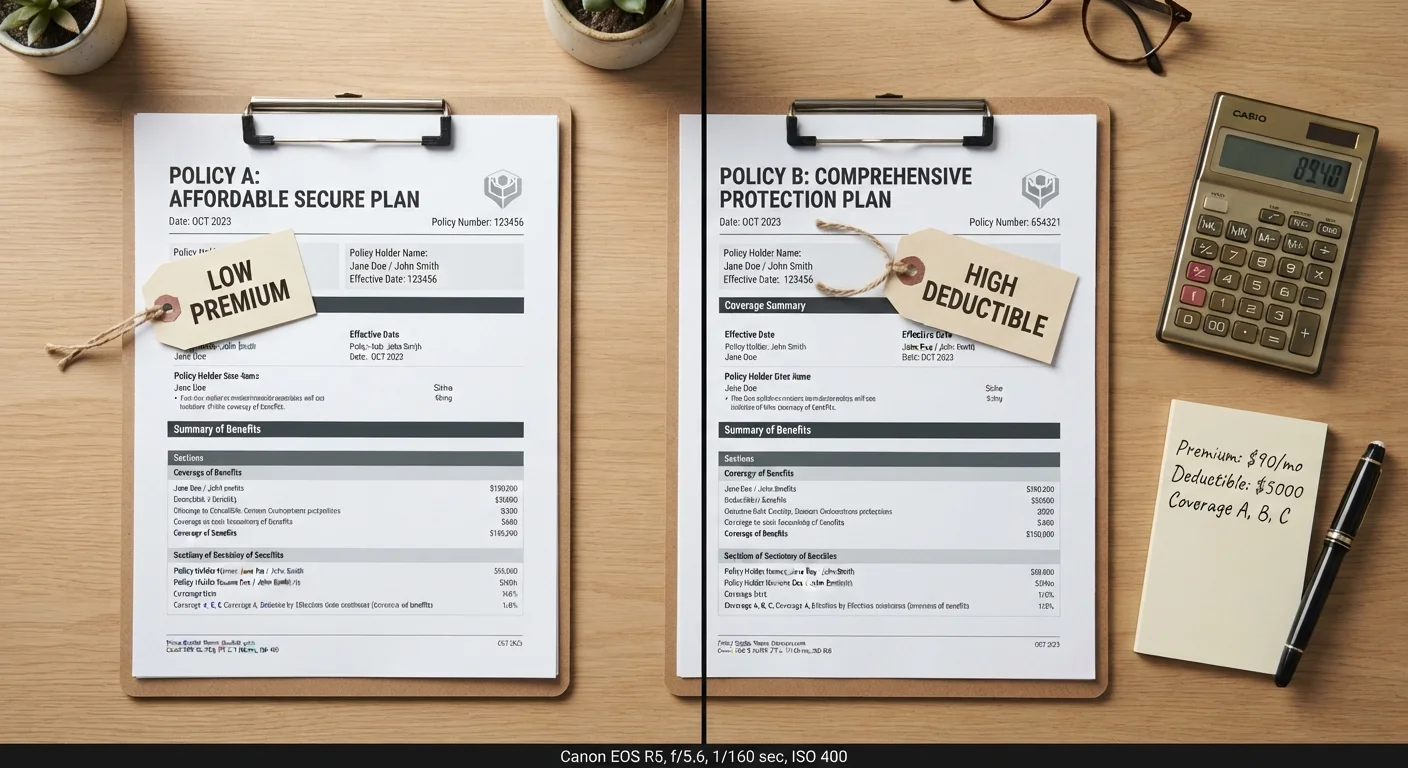
Premium vs. total cost: A low monthly premium can feel like a bargain, but it often comes paired with a high deductible or narrow coverage. Before comparing plans on premium alone, calculate your realistic worst-case out-of-pocket exposure. Our article on how deductibles actually work walks through the math in detail.
Copay vs. coinsurance: These are easy to confuse. A copay is a flat fee per service; coinsurance is a percentage you owe after your deductible. Many health plans combine both-for instance, a $25 copay for primary care visits but 20% coinsurance for specialist visits after the deductible is met.
The out-of-pocket maximum is your financial ceiling for a policy period. It is one of the most important numbers on any health plan-and one of the most overlooked. Low-premium plans can carry high ceilings, meaning a serious illness or accident could still cause significant financial damage.
40%
Americans who underestimate their deductible
Consumer surveys consistently show a significant share of policyholders cannot accurately state their deductible at the time of a claim.
1 in 3
Households with inadequate emergency savings for a deductible
Federal Reserve data on household financial resilience indicates many Americans lack liquid savings to cover a mid-range deductible without financial strain.
Policy Structure Terms: What's Covered and What Isn't
Once you understand cost terms, the next layer is coverage structure. These concepts define the boundaries of your protection.
Exclusions are the fine print that matters most. Every policy has them. Common exclusions include flood damage on standard homeowners policies, pre-existing conditions in some supplemental plans, and intentional acts across most lines. Never assume something is covered because it isn't listed as excluded-verify it is explicitly included.
The distinction between named perils and open perils (sometimes called all-risk) coverage is particularly important for home and renters insurance. Named perils policies are typically cheaper but leave you uncovered for any event not on the list. Open perils policies cover any cause of loss unless specifically excluded.
Actual Cash Value (ACV) versus replacement cost is another consequential difference. If a covered loss destroys your five-year-old laptop, ACV pays its current depreciated market value-perhaps a fraction of what a new one costs. Replacement cost coverage pays what you'd need to buy a comparable new item. The premium difference between these options is usually modest; the claims-time difference can be substantial.
Riders can expand your coverage meaningfully or add cost with minimal benefit. See our dedicated piece on insurance riders before adding any to your policy.
Full Glossary Reference
Use the definitions below as a quick lookup when reading any insurance document. Terms are defined in plain language; your actual policy wording governs your specific coverage.
Premium
The amount you pay-monthly, quarterly, or annually-to keep your insurance policy active. Paying your premium is what maintains your coverage regardless of whether you file a claim.
Deductible
The amount you must pay out of pocket before your insurer begins covering costs. For example, with a $1,000 deductible, you cover the first $1,000 of a covered loss.
Copay
A fixed dollar amount you pay for a specific covered service, commonly used in health insurance. A $30 copay for a doctor visit means you pay $30 regardless of the total bill.
Coinsurance
The percentage of covered costs you share with your insurer after meeting your deductible. An 80/20 plan means your insurer pays 80% and you pay 20% of remaining eligible expenses.
Out-of-Pocket Maximum
The most you will pay in a policy period for covered services. Once you hit this limit, your insurer typically covers 100% of additional eligible costs for the remainder of that period.
Rider
An optional add-on to a base insurance policy that modifies or expands coverage, sometimes for an extra premium. Examples include accidental death riders on life insurance or water backup riders on homeowners policies.
Exclusion
A specific condition, event, or circumstance that a policy explicitly does not cover. Reading the exclusions section is critical to understanding the real limits of any policy.
Claim
A formal request you submit to your insurer asking for payment or coverage for a loss or event covered by your policy. The insurer reviews the claim before approving or denying payment.
Underwriting
The process insurers use to evaluate applicant risk and determine whether to offer coverage and at what premium. Factors may include age, health history, credit score, or property condition depending on the policy type.
Policyholder
The person or entity that owns the insurance policy and is responsible for paying premiums. The policyholder may or may not be the same as the insured or the beneficiary.
Beneficiary
The person or entity designated to receive the payout from a life insurance policy or similar benefit when a covered event occurs. You can typically name or update beneficiaries at any time.
Subrogation
The legal process by which your insurer steps into your shoes to recover money from a third party responsible for your loss-after paying your claim. This can affect any settlement you receive from that third party.
This article is for general informational purposes only and does not constitute personalized insurance, financial, or legal advice. Coverage terms, exclusions, premiums, and regulations vary by provider, policy type, and state. Consult a licensed insurance agent or adviser for guidance specific to your situation.