
The Core Mechanic: How a Deductible Actually Works
Think of a deductible as your financial commitment before insurance shares the burden. When you file a covered claim, your insurer doesn't pay the entire amount from dollar one - you absorb the first chunk up to your deductible, then the insurer handles the rest.
Here's a straightforward breakdown:
- You have a $500 auto deductible. A minor collision causes $2,200 in damage. You pay $500; your insurer pays $1,700.
- You have a $2,500 health deductible. A medical procedure costs $1,800. You pay the full $1,800 - you never hit your deductible, so insurance doesn't contribute to that bill.
This is why deductible selection isn't just a number on a form. It defines the real-world cost you'd face during a stressful moment - an accident, a hospital visit, a burst pipe.
Deductibles Don't Apply to Every Line Item
Some insurance claims are exempt from deductibles. Under the Affordable Care Act, most health plans must cover a defined set of preventive services - like annual wellness visits and recommended screenings - at no cost to you, meaning your deductible doesn't apply. On auto policies, some insurers offer full glass coverage with no deductible as an add-on. Always review your specific policy terms rather than assuming your deductible applies universally.
The Premium Trade-Off: Lower Deductible vs. Lower Monthly Cost
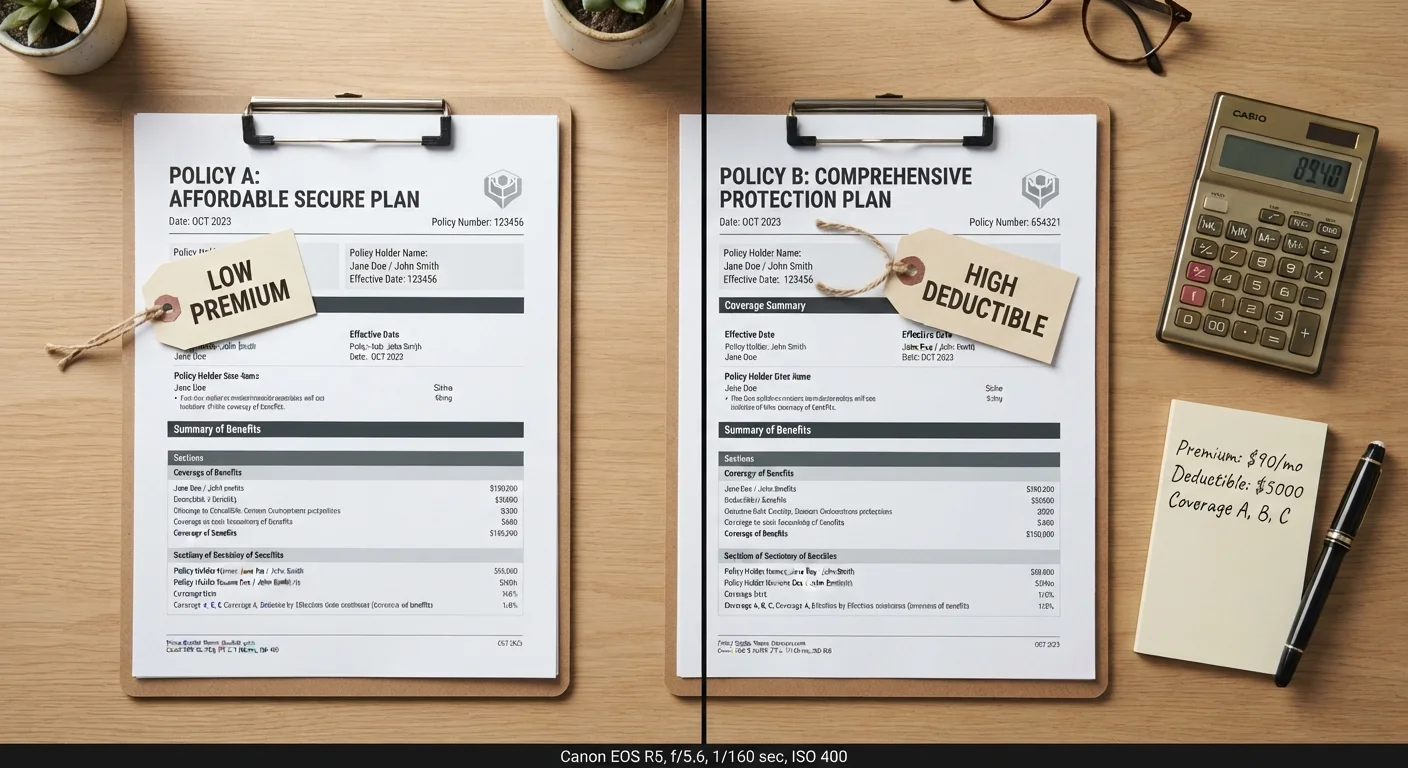
Deductibles and premiums are directly linked. Insurers use your chosen deductible as a signal of risk-sharing: the more you agree to pay upfront in a claim, the less risk the insurer carries - so they charge you less each month.
63%
Americans who couldn't cover a $500 emergency
A survey by Bankrate found that a significant share of U.S. adults could not pay an unexpected $500 expense from savings alone - underscoring the importance of matching deductibles to real cash availability.
$1,763
Average individual health deductible (employer plans)
According to KFF's 2023 Employer Health Benefits Survey, the average annual deductible for single coverage in employer-sponsored plans was approximately $1,763.
This trade-off means there's no universally correct deductible. The right number depends on your personal financial cushion. Ask yourself one direct question: If I filed a claim tomorrow, could I pay my deductible from savings or cash flow without going into debt? If the answer is no, your deductible is too high - regardless of how appealing the lower premium looks. See our guide on why cheap insurance can cost more for a deeper look at how premium-focused decisions can backfire.
For guidance on building the kind of savings buffer that makes a higher deductible manageable, the Budgeting Basics hub is a practical starting point.
Deductibles Across Insurance Types
Deductibles don't behave identically across every policy. Understanding how they vary helps you plan more accurately.
Health Insurance
Health deductibles typically reset every plan year. Many preventive services - screenings, vaccinations - are covered before you meet your deductible under ACA-compliant plans. Family plans often have both individual and combined family deductible thresholds.
Auto Insurance
Auto policies usually carry separate deductibles for collision (damage from an accident you're involved in) and comprehensive (theft, weather, falling objects). You choose each independently. Factors beyond deductibles also shape your overall auto insurance cost - learn what else drives your auto premium.
Homeowners and Renters Insurance
Standard home policies carry a flat deductible, but some policies use percentage-based deductibles for specific perils like wind or hail - calculated as a percentage of your home's insured value rather than a fixed dollar amount. This distinction matters significantly in high-risk regions.
This article is general insurance education and not personalized advice. Policy terms vary by insurer and state. Consult a licensed insurance agent for guidance specific to your situation.
Choosing a Deductible That Actually Fits Your Budget
Selecting a deductible is a budgeting decision as much as an insurance one. A few practical steps help align it with your real financial position:
- Know your emergency fund. A commonly cited guideline is having three to six months of expenses saved. Your deductible should not exceed what you could realistically access quickly in an emergency.
- Calculate your annual premium savings. Compare quotes at different deductible levels. If moving from a $500 to a $1,000 deductible saves $120 per year in premiums, you'd need roughly four years of claim-free coverage to break even - but one claim flips that math immediately.
- Consider your claim likelihood. Older vehicles with higher accident risk, properties in flood-prone areas, or families with heavy medical needs may warrant a lower deductible despite the premium cost.
Match Your Deductible to Your Savings, Not Your Optimism
Before finalizing any deductible, check your actual liquid savings - not what you expect to save or what you'd put on a credit card. Your deductible should be an amount you could pay today without financial hardship. If that number is $500, a $2,000 deductible is a risk, not a bargain.
Reviewing your deductible annually - especially after major life changes like income shifts or new dependents - helps ensure your coverage structure still matches your financial reality. Many people also unknowingly overpay in other areas; see how people overpay for insurance without realizing it.