Why Your Shopping Cart Shapes Your Diet More Than Your Willpower Does
What ends up in your kitchen largely determines what ends up on your plate. Yet most nutrition conversations focus on meal prep, recipes, or calorie counts - not the grocery run that makes any of that possible. The truth is, a handful of very common shopping habits quietly undermine nutrition goals before a single meal is cooked.
This isn't about rigid meal planning or spending more money. It's about recognizing patterns that most shoppers fall into without realizing it. For a grounding primer on eating well within a real budget, see our practical nutrition guide.
Shopping without a list or loose meal plan.
Why it happens: Most people head to the store with a general idea of what they need, relying on memory and in-store prompts - which are designed to encourage unplanned purchases.
Shopping on an empty stomach.
Why it happens: Hunger amplifies the appeal of calorie-dense, heavily packaged foods, and shoppers in a hungry state consistently choose more processed and snack-type items than they intended to.
Trusting front-of-package health claims without reading the nutrition label.
Why it happens: Words like "natural," "wholesome," or "made with whole grains" are marketing terms, not regulatory standards. They create a health halo that can lead shoppers to overlook the actual ingredient list and nutrient breakdown.
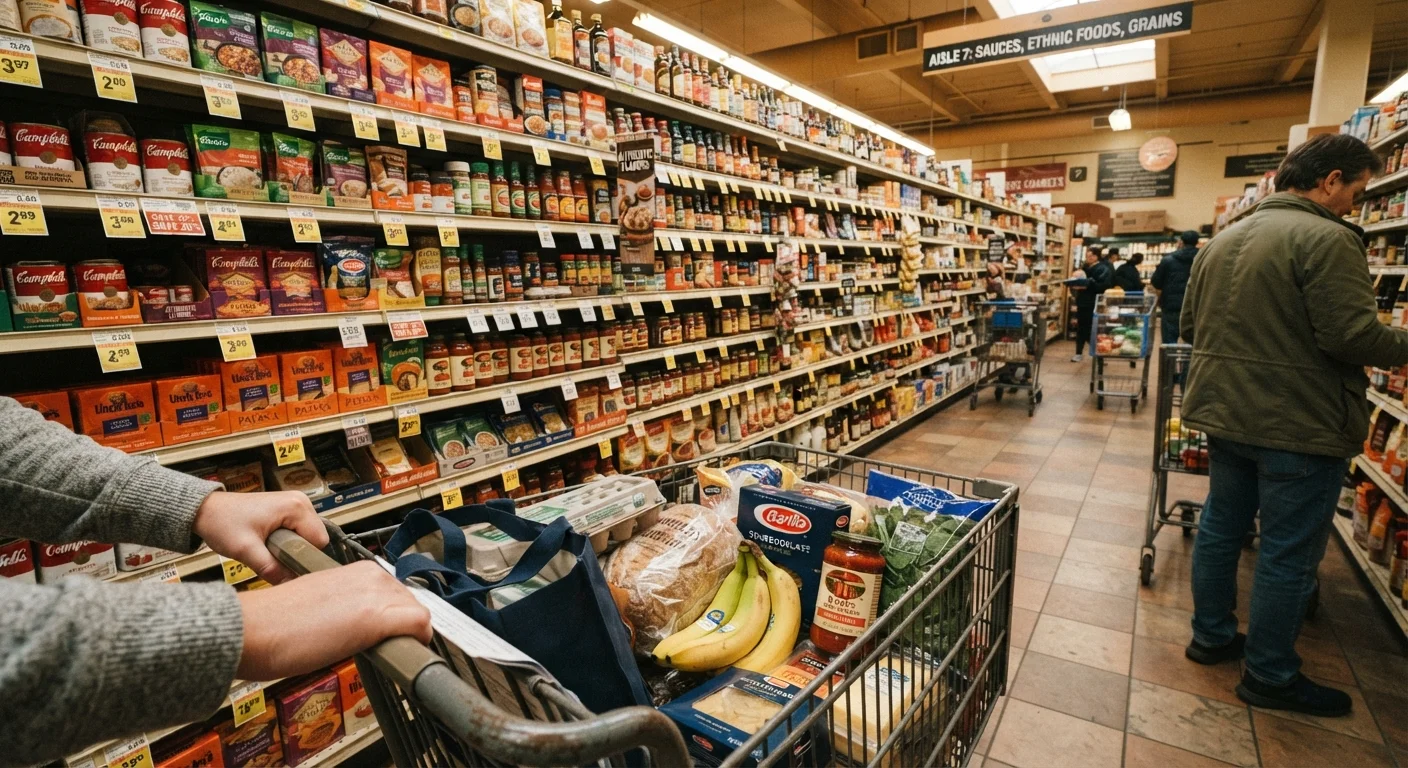
Bypassing the perimeter of the store in favor of the center aisles.
Why it happens: Packaged goods in center aisles are heavily promoted, competitively priced, and easy to grab - while fresh produce, proteins, and dairy along the store perimeter require more thought and preparation.
Choosing "diet" or "low-fat" versions automatically.
Why it happens: Decades of marketing have conditioned shoppers to equate reduced fat with healthier, without accounting for what is often added - typically sugar or sodium - to compensate for flavor loss.
Underbuying perishables to avoid waste, then defaulting to processed foods mid-week.
Why it happens: Concerns about food spoilage are legitimate and budget-driven. But the result is often a refrigerator that empties by Wednesday, leaving shelf-stable, processed options as the default for the rest of the week.
The Numbers Behind the Habits
Research on food environments and purchasing behavior consistently shows that context - store layout, hunger state, label framing - shapes decisions more than most shoppers expect. Understanding the scale of these influences helps explain why individual habits are worth examining carefully.
~58%
Of daily calories from ultra-processed foods
Research published in the BMJ estimated that ultra-processed foods account for roughly 58% of daily caloric intake among U.S. adults - much of it driven by what's routinely purchased.
1 in 10
U.S. adults meet vegetable intake recommendations
CDC data has consistently shown that only about 1 in 10 American adults meets federal dietary guidelines for vegetable consumption, a gap that often starts at the grocery store.
~95%
Of Americans under-consume dietary fiber
The Dietary Guidelines for Americans identifies fiber as a "nutrient of public health concern," with an estimated 95% of Americans falling short of recommended daily intake.
These patterns have real nutritional consequences. Micronutrient shortfalls, for instance, are partly a downstream effect of what people routinely select - or skip - at the store. Our article on common micronutrient deficiencies explores which gaps show up most frequently and why.
"Health" Labeling Is Not Regulated the Way You Might Think
Terms like "natural," "clean," or "wholesome" on food packaging carry no standardized legal definition in the U.S. and are not verified by a regulatory body before they appear on shelves. Only specific claims - such as "low sodium" or "good source of fiber" - are defined by the FDA. When in doubt, rely on the nutrition facts panel and ingredient list, not front-label language.
Before your next shopping trip, it's also worth applying a quick decision framework. The pre-purchase checklist approach - originally framed around general shopping - translates well to the grocery context. And if you want a concrete starting point, our week of nutritious eating checklist offers practical pantry and label guidance to set you up before the week begins.
This article is for general informational and educational purposes only and does not constitute medical or nutritional advice. Consult a qualified healthcare professional or registered dietitian for guidance specific to your health needs.