What an EnergyGuide Label Actually Is
The bright yellow EnergyGuide label is a federally required disclosure, not a marketing tool. The U.S. Federal Trade Commission (FTC) mandates that manufacturers place these labels on most major household appliances - including refrigerators, dishwashers, washing machines, water heaters, and room air conditioners - before they reach store shelves.
Its purpose is straightforward: give shoppers a standardized, comparable snapshot of how much energy an appliance uses and what that energy is likely to cost annually. Think of it as a fuel economy sticker for your home - similar in concept to the EPA window label on a new car.
If you're already comfortable decoding other product labels, you'll find the EnergyGuide format relatively compact. For a broader reference on appliance terminology that sometimes appears alongside these labels, see A Shopper's Glossary of Home Appliance Terms.
What you will need
The Five Sections of the Label, Explained
Every EnergyGuide label contains the same core sections. Here's what each one actually communicates:
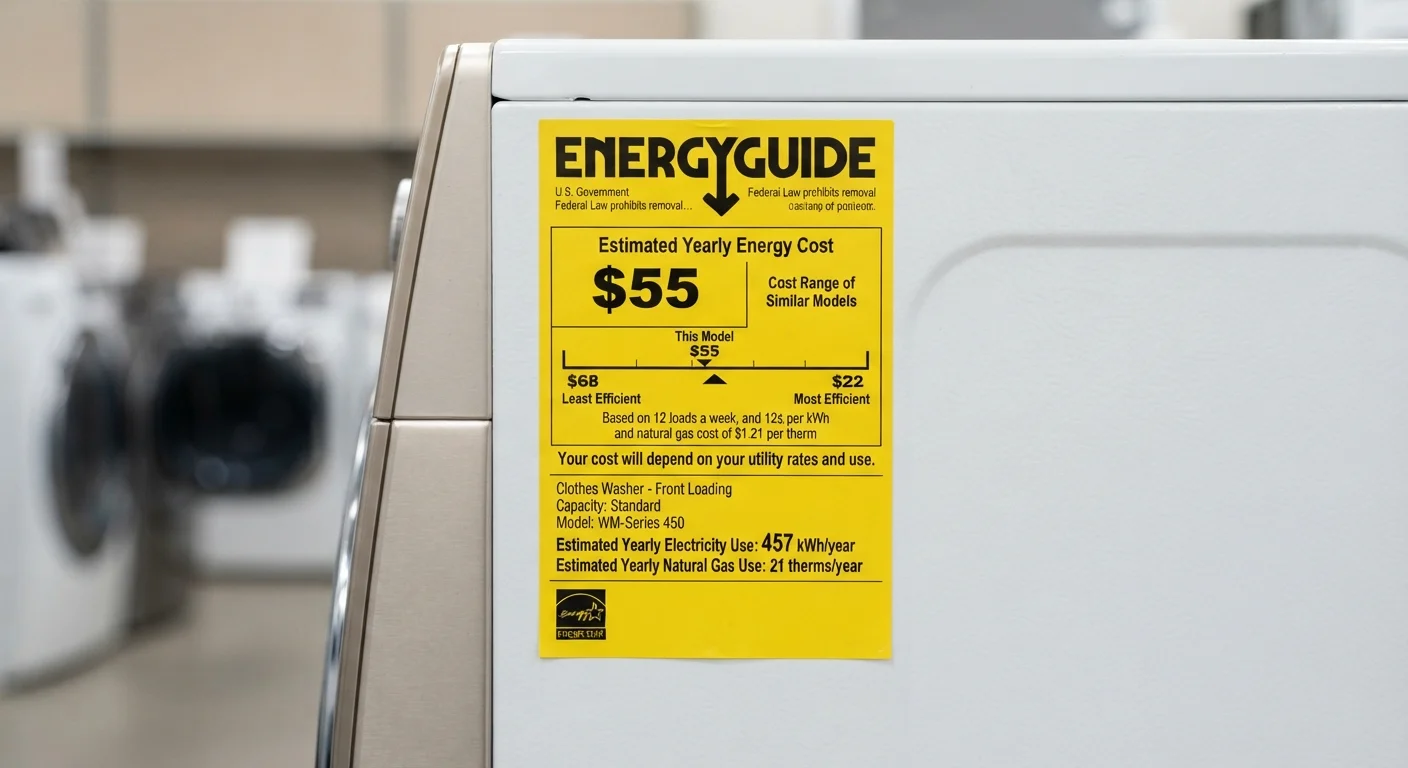
- Appliance type and key features: At the top, the label identifies the product category and specific characteristics used in the test - capacity for a refrigerator, for instance. This defines the comparison group.
- Estimated yearly energy cost: The large dollar figure in the center is the headline number. It's calculated using a national average energy rate set by the FTC, not your local utility rate. That means it's a useful benchmark for comparing models against each other, but it won't match your actual annual bill.
- Estimated energy use (kWh/year): Below or near the cost figure, you'll find the kilowatt-hours consumed per year. This is the raw number - and it's more durable for comparison purposes because it doesn't change when electricity prices do.
- Comparison scale: A horizontal bar showing where this appliance falls between the least and most efficient models in the same product category and size class. Lower on the scale means lower energy use relative to comparable models.
- ENERGY STAR notice: If present, a note indicates the appliance has earned ENERGY STAR certification, meaning it meets efficiency thresholds set by the EPA - above and beyond the federal minimum standard.
kWh Is the More Reliable Number
When comparing two appliances side by side, focus on the kWh/year figure rather than the estimated dollar cost. The dollar figure shifts whenever the FTC updates its assumed electricity rate, while kWh reflects the actual physical energy the appliance consumes. Use kWh for apples-to-apples comparisons, then apply your own local rate to get a realistic cost estimate.
How to Use the Label When Evaluating Operating Costs
The label becomes most useful when you treat it as a comparison tool rather than a precise cost prediction. Here's a practical approach:
Locate the kWh per year figure
Find the estimated annual energy use expressed in kilowatt-hours (kWh) on the label. This is more stable than the dollar cost figure because it reflects the appliance's actual energy draw, independent of electricity pricing.
Find your local electricity rate
Pull up a recent utility bill and locate the rate you pay per kWh. This is typically listed on the bill as a cents-per-kWh figure. Rates vary significantly by region and season.
Calculate your estimated annual operating cost
Multiply the label's kWh/year figure by your local rate (converted to dollars per kWh). For example: if the label shows 500 kWh/year and you pay $0.14/kWh, your estimated annual cost is $70.
Formula: kWh/year × (your rate in $/kWh) = estimated annual cost
Read the comparison scale in context
Look at where the appliance sits on the horizontal efficiency scale. Models positioned toward the lower-cost end of the scale use less energy than others in the same category and size class. Compare multiple models using the same scale to see relative differences.
Note ENERGY STAR status separately
If the label includes an ENERGY STAR logo or notice, record it as a separate data point. ENERGY STAR certification indicates the model meets EPA efficiency criteria, which can also affect eligibility for utility rebates or tax credits in some jurisdictions.
Once you've worked through the calculation, keep in mind that operating cost is one component of total ownership cost - purchase price, expected lifespan, repair history for that product category, and rebate availability all factor in. Before diving into side-by-side model comparisons, it helps to have a framework. See Questions Worth Asking Before Comparing Any Two Home Appliances for a structured starting point.
Common Misreads and What to Watch For
A few misconceptions trip up even careful shoppers:
- The cost figure isn't your cost. The FTC updates its assumed electricity rate periodically, but it will rarely match your local rate precisely. Always use your actual rate from a recent utility bill.
- The comparison scale is category-specific. A refrigerator's scale only compares refrigerators of similar capacity. It tells you nothing about how the appliance compares to a different appliance type.
- ENERGY STAR is not the same as "most efficient." It means the appliance meets a defined threshold - but multiple models at different efficiency levels can carry the certification.
- Usage assumptions may not match your household. The label's kWh figure is based on standardized usage patterns. A household that runs a dishwasher twice daily will see higher actual costs than the label suggests.
Label Data Reflects Standardized Conditions
EnergyGuide estimates are produced under controlled test conditions that may differ from real-world use in your home. Factors like installation environment, local climate, usage frequency, and household habits can all cause actual energy consumption to deviate - sometimes substantially - from the label figure. Treat the label as a comparative tool, not a guaranteed cost prediction.
This article is for general informational purposes only. Energy costs vary based on your utility provider, local rates, usage habits, and appliance settings. Consult your utility company or a qualified energy auditor for advice specific to your home.