Why Knife Specs Actually Matter
A kitchen knife is one of the few tools you'll use every single day, which makes it worth understanding before you buy. Spec sheets and product listings throw around terms like Rockwell hardness, full tang, and convex grind - but without context, those words don't help you compare anything. This reference breaks down each major category so you can decode what you're actually looking at.
For shoppers building out a kitchen from scratch, pairing this knowledge with a broader setup plan pays off. See our guide to equipping a kitchen on a budget for a practical starting point.
| Common HRC range (Western knives) | 54-58 HRC |
| Common HRC range (Japanese knives) | 60-66 HRC |
| Typical double-bevel angle (Western) | 20°-25° per side |
| Typical double-bevel angle (Japanese) | 10°-15° per side |
| Most durable handle material | G-10 (fiberglass laminate) |
| Most sanitary handle for home kitchens | Polypropylene / synthetic polymer |
Steel Grades and What They Mean
The steel a blade is made from determines how sharp it can get, how long it holds that edge, and how much maintenance it needs. Most kitchen knives fall into a few broad categories:
- High-carbon stainless steel - the most common choice in mid-range knives. It resists rust better than plain carbon steel and holds a reasonably sharp edge. Look for grades like 1.4116 (often labeled X50CrMoV15) in this tier.
- High-carbon steel (non-stainless) - sharpens to a finer edge and is often found in professional-grade or Japanese-style blades. Requires drying after use to prevent rust and discoloration.
- Stainless steel (basic) - common in entry-level knives. Corrosion-resistant but typically softer, meaning it dulls faster and is harder to restore to a fine edge.
- Powder metallurgy (PM) steels - used in premium Japanese knives (e.g., SG2, HAP40). Very fine grain structure allows exceptional sharpness, but the steel is more brittle and less forgiving of hard use.
Rockwell Hardness (HRC) is the standard scale for measuring steel hardness. Most Western-style knives fall in the 54-58 HRC range; Japanese knives often run 60-66 HRC. Harder steel holds an edge longer but chips more easily if used carelessly.
Rockwell Hardness (HRC)
A standardized scale measuring how resistant a material is to surface deformation. For kitchen knives, higher HRC ratings generally mean better edge retention but increased brittleness.
Tang
The portion of the blade steel that extends into the handle. A full tang runs the entire handle length; a partial tang does not. Tang length affects balance and long-term durability.
Bevel
The angled surface ground on one or both sides of a blade to create the cutting edge. The angle (measured in degrees per side) determines sharpness and edge durability.
Grind
The cross-sectional geometry of a blade from spine to edge. Common types include flat, hollow, and convex grinds, each affecting cutting performance and sharpening method.
Single Bevel
An edge sharpened on only one side of the blade, common in traditional Japanese knives. Produces a very acute, precise edge but requires sided sharpening technique.
High-Carbon Steel
Steel with a relatively high carbon content, which allows it to achieve and hold a sharper edge than standard stainless. More reactive to moisture and acidic foods without proper care.
Full Tang
A construction where the blade steel extends the full length of the handle, typically sandwiched by two handle scales. Associated with better balance and structural longevity.
G-10
A high-pressure fiberglass laminate used for knife handles. Extremely durable, moisture- and chemical-resistant, and available in various textures for grip security.
Edge Geometry: Grinds and Bevel Angles
The grind is the cross-sectional shape of a blade from spine to edge. It affects cutting feel, food release, and how the knife is sharpened.
- Flat grind - a straight taper from spine to edge, common on Western knives. Durable and easy to sharpen at home.
- Hollow grind - slightly concave sides create a very thin edge, extremely sharp but more fragile. Often seen on Japanese single-bevel knives.
- Convex grind - outward-curved sides. Strong and food-releasing, common on cleavers and some Scandinavian blades.
- Single bevel vs. double bevel - Western knives are typically sharpened symmetrically on both sides (double bevel, often 20°-25° per side). Many Japanese knives are sharpened on one side only (single bevel), allowing a more acute, precise edge but requiring sided sharpening technique.
A lower bevel angle means a sharper but more delicate edge. A higher angle is more robust and better suited to heavy tasks like breaking down poultry or cutting hard squash.
Sharpening Method Depends on Edge Type
Single-bevel knives cannot be sharpened on a standard pull-through sharpener - they require whetstones and technique specific to the beveled side. Double-bevel Japanese knives at low angles also perform best on whetstones rather than electric sharpeners, which can remove too much material. Check your knife's edge type before buying a sharpener.
Handle Materials at a Glance
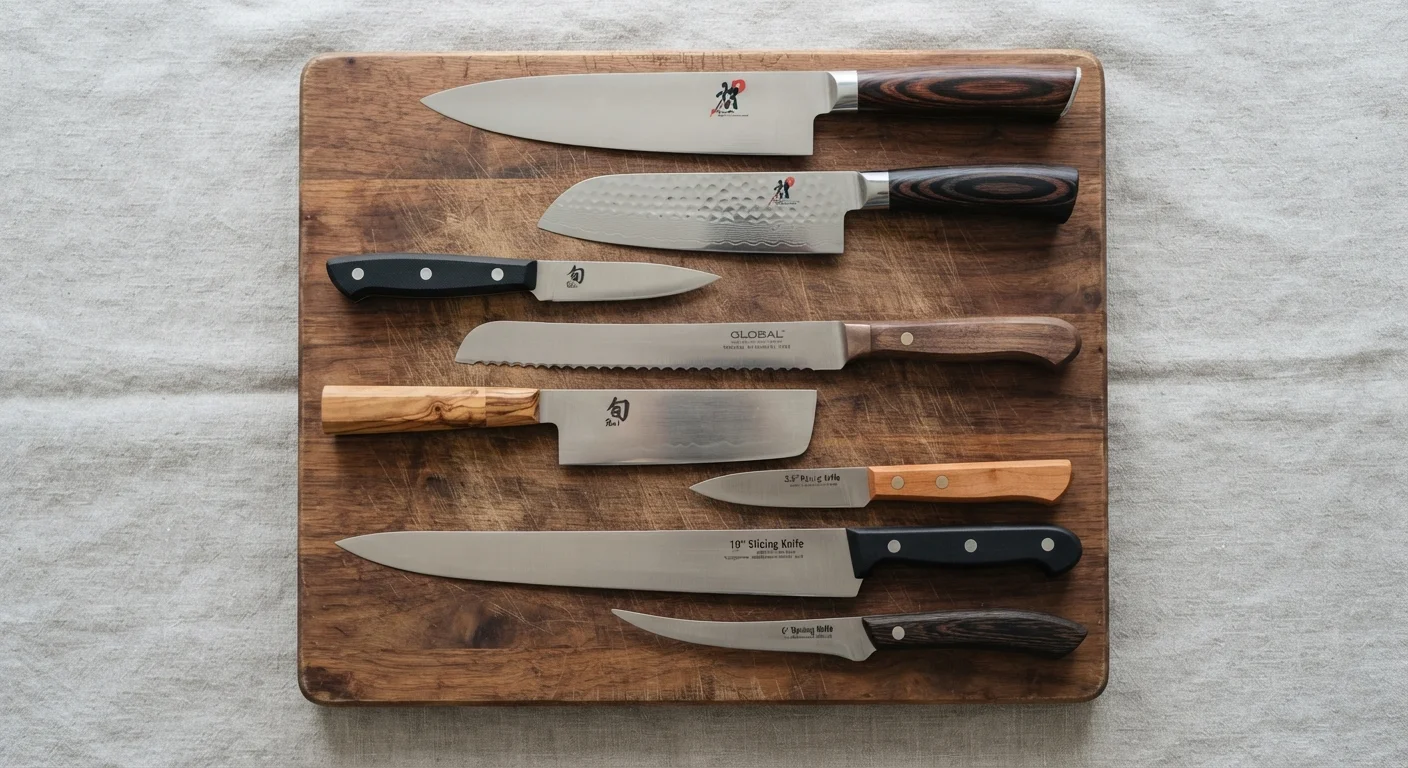
Handle material affects grip security, hygiene, durability, and weight balance. Common options include:
- Pakkawood / resin-stabilized wood - real wood layers compressed with resin. More moisture-resistant than plain wood, comfortable grip, visually appealing. Not dishwasher-safe.
- Polypropylene / Fibrox - textured synthetic plastic, sanitary, dishwasher-safe, and non-slip when wet. Standard in commercial kitchens for good reason.
- G-10 (fiberglass laminate) - dense, textured, extremely durable. Common on higher-end knives. Resists heat, moisture, and chemicals.
- Stainless steel handles - sleek and fully sanitary, but can feel slippery; look for texture or finger grooves. Heavier, which shifts balance toward the handle.
- Natural wood - warm and grippy when dry, but swells with moisture over time and requires hand-washing and occasional oiling.
Tang refers to how far the blade steel extends into the handle. A full tang (steel runs the full length of the handle, sandwiched by scales) is generally more balanced and durable. A partial tang is lighter and common in lighter Japanese wa-handles, but can loosen over time if construction quality is low.
If you're also thinking through pots and pans alongside your knife setup, our cookware comparison covers what actually matters when choosing between cast iron and stainless steel.