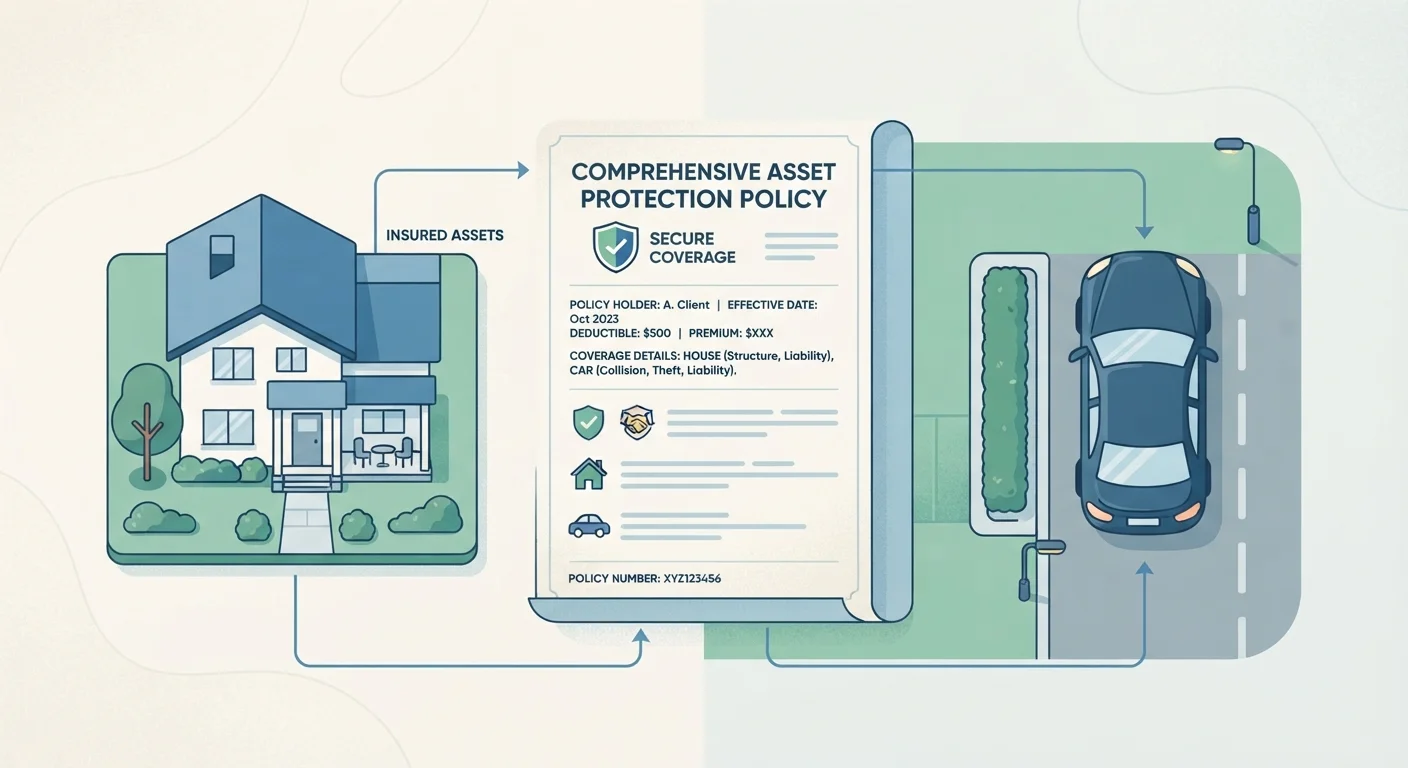

Why Savings and Insurance Must Work Together
Most people treat savings and insurance as separate buckets - one for building wealth, one for disaster. That framing leaves a gap that costs real money. These two tools are designed to cover different risk scenarios, and when aligned, they form a protective system that's greater than the sum of its parts.
Insurance handles large, low-probability losses - a house fire, a car accident, a medical emergency. Savings handle frequent, smaller shocks - a job loss, a broken appliance, an unexpected travel expense. Relying solely on insurance for everything means paying premiums for risks you could absorb yourself. Relying solely on savings means a single catastrophic event can wipe out years of effort.
See how these two pillars interact in detail: Emergency Fund vs. Insurance: Two Pillars of Financial Protection.
57%
Americans unable to cover a $1,000 emergency
According to Bankrate's 2024 Annual Emergency Savings Report, more than half of U.S. adults could not pay a $1,000 unexpected expense from savings alone.
$2,500+
Average annual health insurance deductible
The Kaiser Family Foundation's 2023 Employer Health Benefits Survey found average individual deductibles for employer-sponsored plans exceeded $1,700, with many plans considerably higher.
3-6 months
Recommended emergency fund target
Most mainstream personal finance guidance, including guidance from the Consumer Financial Protection Bureau (CFPB), points to three to six months of essential expenses as a practical target.
How Much to Save Before Prioritizing Insurance
For budget-conscious households, the common question is sequencing: should you build savings first, or lock in coverage first? The practical answer is to do both at a modest level simultaneously, then scale each deliberately.
Start with a starter emergency fund - a modest cash cushion held in a liquid account - before aggressively increasing coverage. This small reserve prevents you from reaching for a credit card the moment a deductible comes due. Without it, even well-chosen insurance can create financial strain at the worst moment.
Once that cushion is in place, focus on ensuring you carry the coverage types legally required or practically essential in your situation - auto liability, renter's or homeowner's insurance, and basic health coverage. Then expand both savings and coverage in tandem as your income allows.
For practical steps on building savings even on a tight income, see Building a Savings Safety Net on a Tight Budget.
Build your starter emergency fund to at least one month of essential expenses before raising any deductibles. That single step closes the most common coverage-gap trap budget households fall into.
Raising a deductible without corresponding savings creates an unfunded liability - a gap between what you owe at claim time and what you can actually pay, often leading to high-interest debt.
When reviewing policies, ask your insurer specifically what your maximum out-of-pocket exposure is across all policies combined - not just per policy. That total is your true financial risk floor.
Households often track deductibles individually but fail to see the cumulative exposure if multiple claims occur in the same year, which is when financial strain is already highest.
Choosing the Right Coverage Levels Without Overpaying
Coverage levels are where savings and insurance intersect most directly. Your deductible - the amount you pay out of pocket before insurance kicks in - is the clearest example. A higher deductible typically lowers your premium. But that math only works in your favor if your savings can reliably cover that deductible without stress.
A common approach is to set your deductible at or slightly below your emergency fund balance. That way, you're not paying for coverage you've effectively self-funded, but you're also not exposed to a gap you can't bridge.
Match Your Deductible to Your Savings Balance
Before adjusting any deductible, check your liquid savings balance first. A practical rule of thumb: keep your deductible at or below what you could access within one week without borrowing. This keeps your insurance-savings system internally consistent and avoids costly surprises at claim time.
Beyond deductibles, avoid paying for coverage that duplicates protection you already have. Credit card travel insurance, for example, may overlap with a standalone travel policy. Reviewing bundling options is also worth the effort - though bundling isn't always the right move for every household. Evaluate it carefully using this guide: How Bundling Insurance Policies Works-and When It Actually Saves Money.
Making the Two Systems Talk to Each Other
An integrated approach means your savings and insurance decisions actively inform one another. Here are practical ways to connect them:
- Use savings growth to unlock lower premiums. As your emergency fund grows, consider raising deductibles on auto and home policies to reduce monthly costs - and redirect those savings back into your fund.
- Map coverage gaps to savings targets. If your health insurance has a maximum out-of-pocket of $4,000, that's a concrete savings target to work toward.
- Reassess annually. Life changes - income, dependents, assets - alter both your savings capacity and your insurance needs. A once-a-year review catches drift before it becomes costly.
“Financial security isn't about having the most insurance or the most savings - it's about having the right balance between the two so that neither is working too hard or left idle.”
— Consumer Financial Protection Bureau, U.S. federal agency providing consumer financial education and protection
For a structured annual review framework, see The Annual Financial Check-Up: A Personal Insurance and Savings Audit.
Common Mistakes That Leave You Exposed
Even well-intentioned savers and policyholders fall into predictable traps. Recognizing them is half the battle.
Don't Cancel Coverage to Fund Savings Faster
It can be tempting to drop a policy temporarily to free up cash for savings goals. For low-stakes coverage this might sometimes make sense, but canceling auto liability, health, or homeowner's insurance creates catastrophic exposure that savings cannot realistically offset. A single large claim can set back years of savings progress. Reduce premiums through deductible adjustments or bundling reviews instead.
- Canceling insurance to boost savings faster. This can work temporarily in narrow circumstances, but it exposes you to catastrophic risk. Insurance and savings are not substitutes.
- Setting deductibles higher than your actual savings. If your deductible is $2,500 but your emergency fund holds $800, you're absorbing risk you haven't actually funded.
- Buying coverage for peace of mind on low-stakes items. Extended warranties on small electronics or add-on coverage for lost luggage often cost more than the risk they cover. Self-insurance through savings is frequently more efficient here.
- Ignoring liability coverage limits. Many people underinsure on liability - particularly auto and home - where a single claim can exceed low default limits and reach personal assets or future earnings.
Your Next Steps: Putting the Plan Together
Building a coherent savings-and-insurance system doesn't require a financial adviser - though consulting one for your specific circumstances is always worthwhile. It requires honest assessment of what you own, what you owe, who depends on you, and what a bad month would actually cost.
Start with these concrete actions:
- List every insurance policy you currently hold and its deductible.
- Compare those deductibles to your current liquid savings balance.
- Identify any coverage gaps - types of risk you carry with no coverage and no savings buffer.
- Set a specific savings milestone tied to your highest deductible or coverage gap.
- Schedule a calendar reminder to revisit both lists in 12 months.
If you're just starting out and building these habits from scratch, Money and Insurance: A Complete Starting Point for New Adults offers a foundational framework. And for broader spending management that makes room for both savings and premiums, explore Budgeting Basics.
Review Your Plan at Least Once a Year
Income changes, new dependents, a home purchase, or a new vehicle can all shift your optimal savings target and coverage needs significantly. A plan that fit your life 18 months ago may leave dangerous gaps today. Build an annual review into your calendar - treat it as a non-negotiable financial maintenance task, not an optional project.
This article is for general informational and educational purposes only and does not constitute personalized financial, insurance, legal, or tax advice. Coverage needs and financial situations vary by individual. Please consult a licensed financial adviser or insurance professional regarding your specific circumstances.