Why Containment Matters - and Why One Size Doesn't Fit All
Containment gear is less about restricting your dog and more about managing the environment so your dog stays safe, your home stays intact, and training can actually work. A puppy left to roam freely is a puppy that chews baseboards, has accidents in hidden corners, and misses the repetition needed to build good habits. An adult dog blocked from the kitchen during meal prep is a calmer, safer household member.
But crates, playpens, and baby gates do meaningfully different jobs - and picking the wrong tool creates frustration for both the owner and the dog. Before comparing features, it helps to be clear on what you actually need: full enclosure, partial restriction, or boundary-setting with visual access.
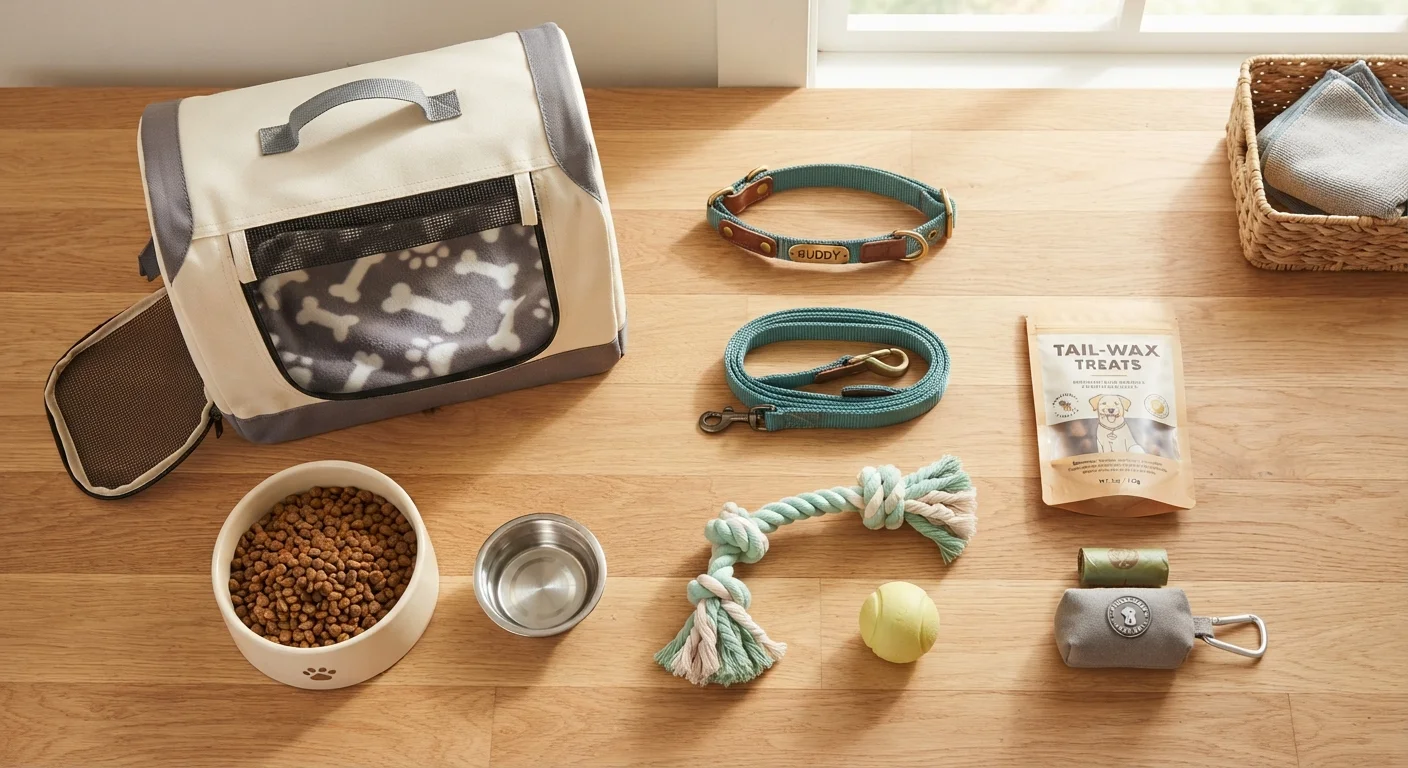
If you're still assembling your dog's initial setup, our first-time dog owner gear guide covers which purchases are genuinely essential on day one versus what can wait.
Dog Crates: Full Enclosure for Training and Security
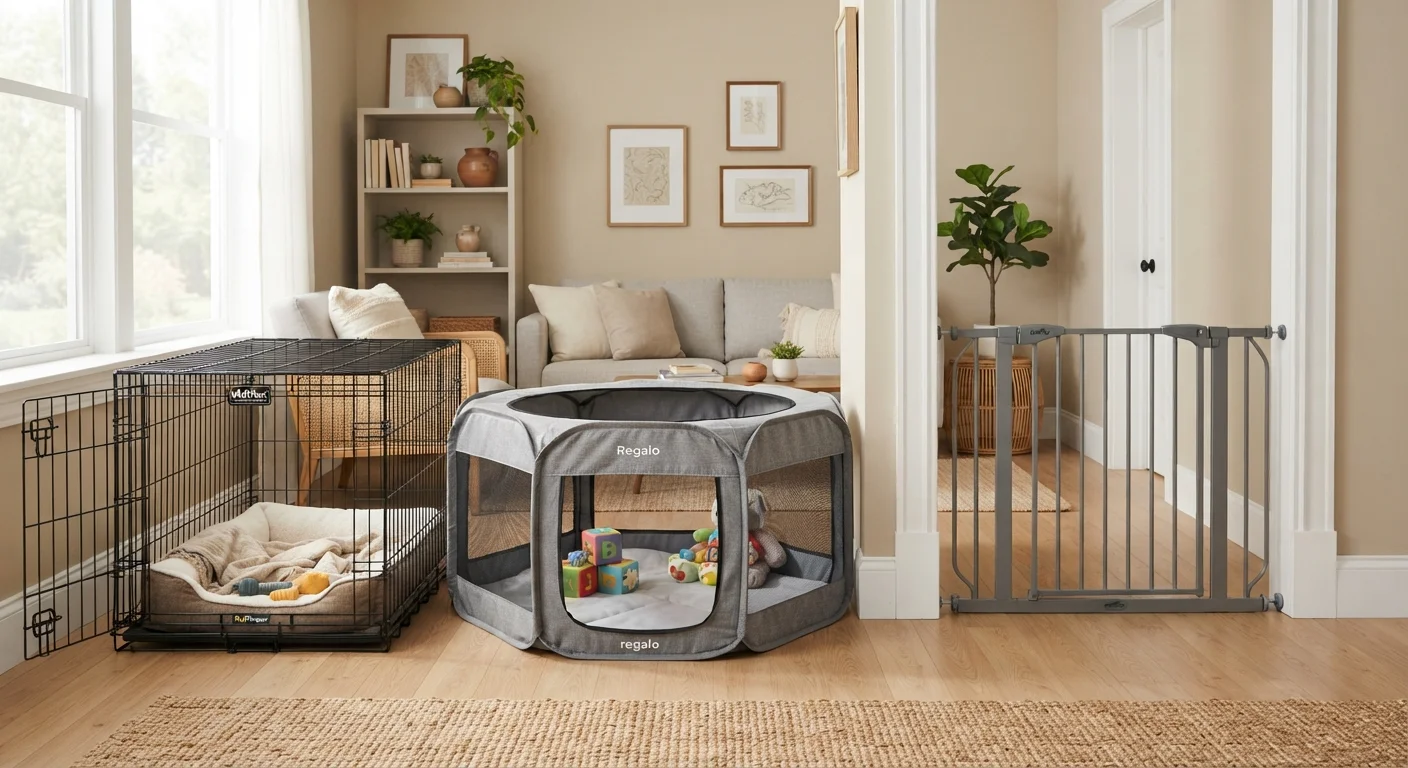
A dog crate - whether wire, plastic, or soft-sided - creates a fully enclosed, den-like space. This serves several real purposes: supporting housetraining (dogs generally avoid soiling where they sleep), preventing destructive behavior when unsupervised, providing a recovery space post-surgery, and enabling safe vehicle transport.
Crates are the most behaviorally grounded of the three options. Dogs introduced to crates gradually and positively often seek them out voluntarily. The key word is gradually - crate training done too quickly, or with a crate that's too large (allowing the dog to eliminate in one corner and sleep in another), undermines the purpose entirely.
Match Crate Size to Your Dog's Current Size
A crate that's too large undermines housetraining by allowing a puppy to eliminate in one area and retreat to sleep in another. For puppies expected to grow significantly, choose a crate with a removable divider panel so you can expand the usable space incrementally as the dog grows. This avoids buying multiple crates across the first year.
Size matters practically: the crate should be large enough for your dog to stand, turn around, and lie down comfortably - but not so spacious that it defeats housetraining by giving room to separate sleep and elimination zones. For growing puppies, a crate with a divider panel lets you adjust the usable space over time without buying multiple crates.
Crates are less suitable as an all-day solution. Extended confinement beyond what's appropriate for the dog's age and bladder capacity can cause anxiety, physical discomfort, and behavioral problems. General guidance from veterinary behaviorists suggests puppies under six months should not be crated for more than three to four hours at a stretch during the day.
Playpens: More Freedom, Less Structure
A dog playpen (sometimes called an exercise pen or x-pen) is an open-topped or covered enclosure, typically modular and expandable, that gives a dog considerably more floor space than a crate. Unlike a crate, a playpen doesn't have a solid roof by default - though covered versions exist for escape-prone dogs.
Playpens are well-suited to situations where you need the dog safely contained but not tightly confined: a puppy during the day when you're working from home, a post-surgical dog who needs restricted movement but not cage rest, or a small dog in a home without good room-blocking options. You can put the dog's crate inside the playpen, giving access to both the den space and open floor area - a setup that many trainers recommend for puppies left alone for a few hours.
The trade-off is security. Determined jumpers or escape artists can defeat many standard playpens, especially as puppies grow. Playpens also occupy significant floor space, which matters in apartments or smaller homes. And because they're more open, they don't provide the same den-like psychological containment that a crate does for anxious dogs.
| Dog Crate | Playpen | Baby Gate | |
|---|---|---|---|
| Confinement level | Full enclosure | Enclosed area, more floor space | Boundary only, no enclosure |
| Best use case | Housetraining, travel, overnight | Daytime supervision, post-surgery | Room restriction, stair blocking |
| Space required | Small footprint | Moderate to large footprint | Minimal - fits doorways |
| Escape risk | Low (latched door) | Moderate (open top) | Moderate (jumpable for large dogs) |
| Suitable for adult trained dogs | Optional/situational | Yes | Yes - most common use |
| Dog visibility to surroundings | Limited (solid panels) or partial (wire) | Partial | High - open sightlines |
| Portability | Moderate to high | Moderate (modular panels) | High (pressure-mount) to low (hardware-mount) |
Baby Gates: Boundary-Setting Without Confinement
Baby gates work differently from the other two options - they restrict access to spaces rather than confining the dog to one. A pressure-mounted gate blocks a doorway; a hardware-mounted gate at the top of stairs prevents falls; a freestanding gate keeps the dog out of the kitchen or away from young children.
Gates are the least confining option and the most compatible with dogs who are already reliably housetrained and generally well-behaved but need access restrictions for safety or management reasons. They're also the most transparent option - the dog can see through most gate styles, which can reduce barking or anxiety compared to a closed door.
Gates are not a substitute for active supervision or training. A dog left on the wrong side of a baby gate can still bark, scratch at the gate, or jump over it if the gate height isn't appropriate for the dog's size. Pressure-mounted gates are generally suitable for interior doorways; for stairs, hardware-mounted installation is strongly recommended for safety - this applies to dogs as well as children.
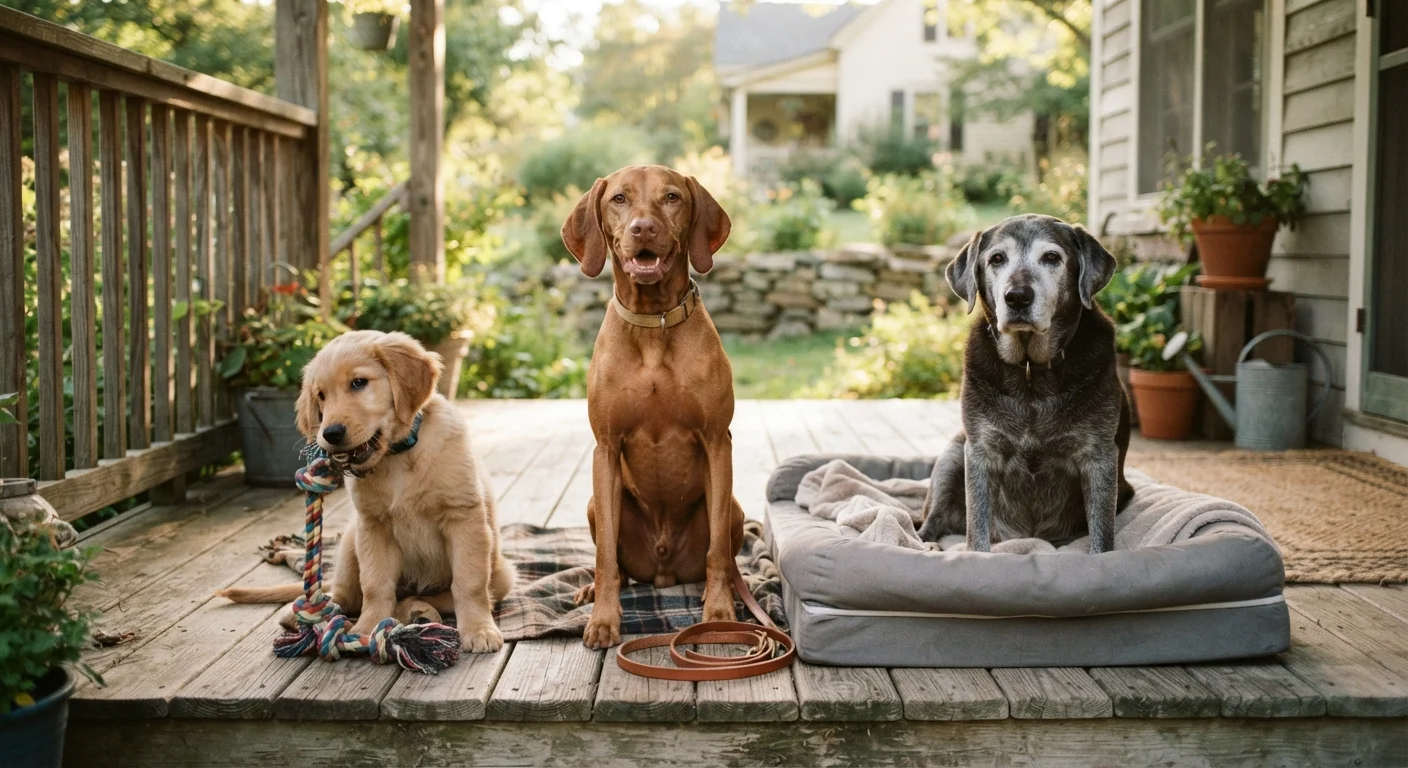
Gear needs evolve as dogs age. Our guide to how pet supply needs shift across life stages explains how containment and other equipment choices typically change from puppyhood through senior years.
Choosing the Right Combination for Your Home
Most real households don't rely on just one option. A common and practical setup: a crate for overnight and short-duration daytime confinement during housetraining, a playpen for extended supervised time during the day, and a baby gate to keep the dog out of off-limits areas once the dog has earned more household freedom.
Consider these factors when deciding:
- Dog's age and size: Puppies need stricter containment; senior dogs may need gates more than crates.
- Housetraining status: Until reliable, a crate remains the most effective tool.
- Home layout: Open-plan spaces are harder to manage with gates alone; playpens or crates fill the gap.
- Duration of confinement: For longer stretches, a playpen is more humane than a crate.
- Behavioral tendencies: Escape-prone or anxious dogs may need more secure options.
For households with multiple dogs, or homes also managing young children, the combination of a crate and a well-placed gate is often the most practical arrangement. Each tool reinforces the other without requiring the dog to spend excessive time in any single space.
This article provides general information for educational purposes and is not a substitute for guidance from a qualified veterinarian or certified dog trainer familiar with your specific dog's needs.