What Each Option Actually Does to Your Dog's Body
The choice between a harness and a collar is fundamentally a question of physics: where does leash tension go when your dog moves against it?
A flat collar concentrates all leash force on a narrow band around the neck. For a dog that walks loosely, this is rarely a problem. But for a dog that pulls - even occasionally - repeated pressure on the trachea, cervical vertebrae, and surrounding soft tissue is a real concern. Veterinary literature has documented associations between collar-induced neck strain and conditions including tracheal collapse, particularly in small-breed dogs and brachycephalic breeds such as Bulldogs, Pugs, and French Bulldogs, whose airways are already anatomically compressed.
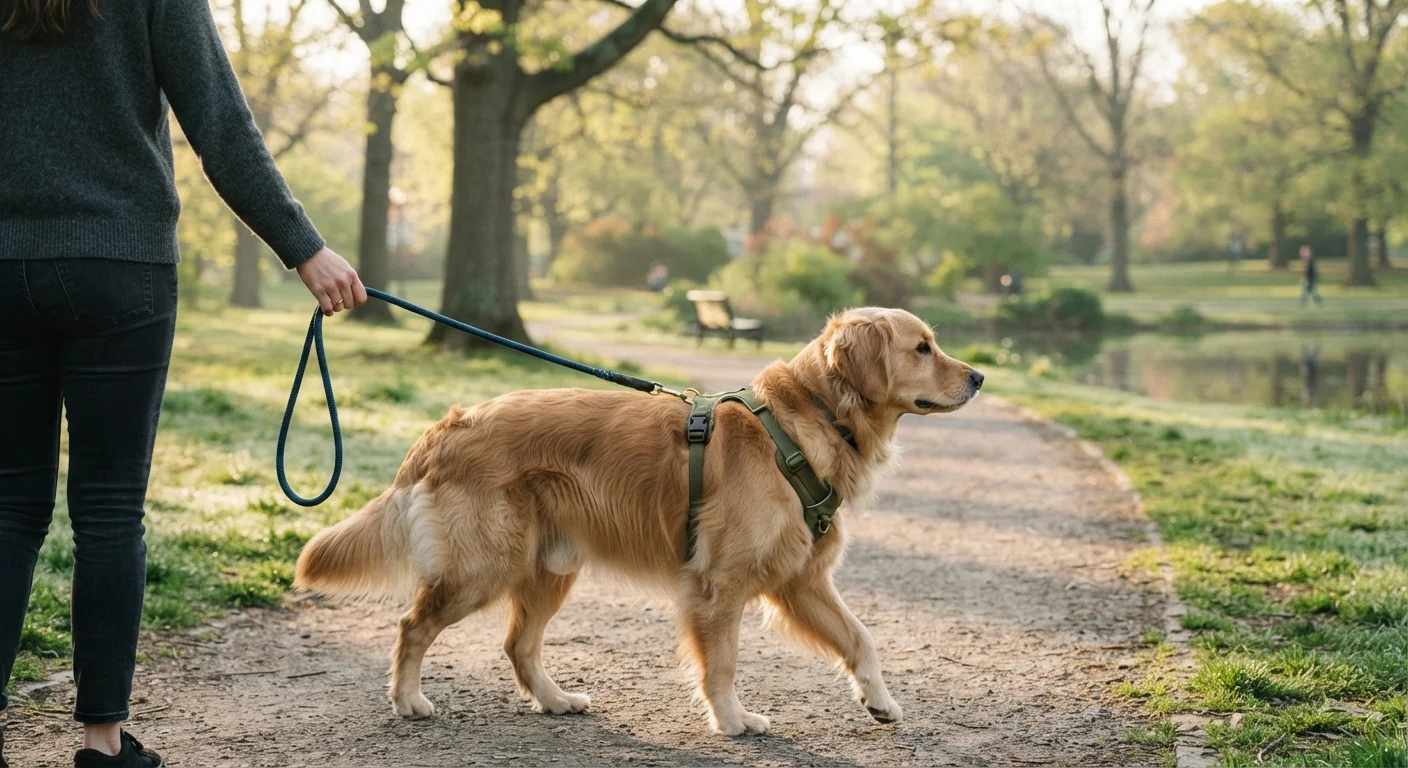
A harness, by contrast, wraps around the dog's chest and torso. Leash tension distributes across the sternum, ribcage, and shoulders - significantly sturdier structures than the neck. This doesn't mean harnesses are without fit-related risks: a poorly fitted harness can chafe the armpits (axillary region), restrict natural shoulder movement, or slip off entirely if the dog backs out of it. Fit and design both matter.
| Criterion | Dog Harness | Dog Collar |
|---|---|---|
| Pressure distribution | Chest, shoulders, torso | Neck and trachea only |
| Tracheal safety | Lower risk | Higher risk for pullers |
| ID tag carrying | Not designed for it | Standard function |
| Handler control | Greater (especially front-clip) | Less with strong pullers |
| Ease of use | More steps to fit and fasten | Simple clip or buckle |
| Risk for small/brachycephalic breeds | Lower | Higher |
| General cost | Typically higher | Typically lower |
It is worth noting that neither option replaces leash training. A harness does not stop a dog from pulling; it simply makes pulling safer and gives the handler more leverage. Owners working on loose-leash walking should combine the right gear with consistent training.
When Collars Make Sense - and When They Don't
Collars remain the most common choice for one straightforward reason: they are practical. They stay on around the clock, hold ID tags and rabies license tags securely, and are easy to clip a leash onto for a quick walk. For a calm, well-trained dog with no respiratory concerns, a properly fitted flat collar is a perfectly reasonable leash-walking tool.
Where collars become problematic is predictable: any dog that pulls regularly, has a known tracheal condition, belongs to a high-risk small breed, or is still learning leash manners should not be walked on a collar alone. Choke chains and prong collars, sometimes marketed as training tools, apply deliberate pressure or pain to the neck to discourage pulling. Mainstream veterinary and behavioral guidance generally advises against these devices, as the aversive stimulus can increase anxiety and does not address the underlying reason a dog pulls.
Martingale Collars: A Middle-Ground Option
Martingale collars are a limited-slip design that tighten slightly under tension - enough to prevent escape, but not enough to choke. They are commonly used for sighthound breeds like Greyhounds and Whippets, whose narrow heads make standard collars easy to slip. They are not intended as correction tools and should be fitted so the collar cannot tighten beyond the width of the dog's neck. A veterinarian or certified trainer can advise whether a martingale design is appropriate for a specific dog.
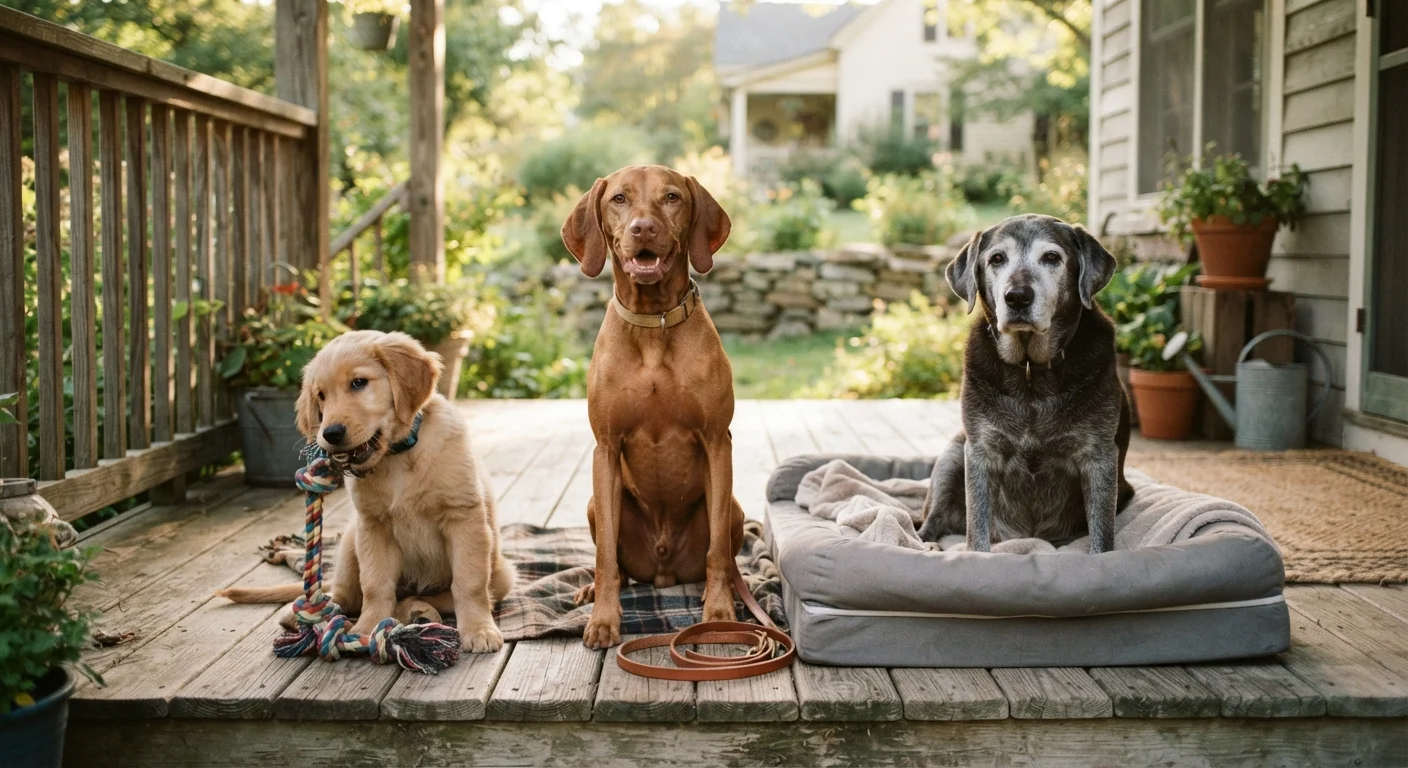
Collars also pose a snag risk indoors - dogs playing together can get a jaw or leg caught in a collar mate's neck strap. Some owners remove collars during unsupervised play and rely on a microchip for permanent identification. See our guide to first-day dog gear for more on building a practical, safe setup from the start.
Choosing and Fitting a Harness Correctly
Harness designs vary considerably, and the differences affect function. Front-clip harnesses attach the leash at the dog's chest, which naturally redirects a pulling dog back toward the handler - useful during training. Back-clip harnesses attach at the spine between the shoulder blades; they are comfortable and low-restriction but give the handler less leverage over a strong puller. Some harnesses offer both clip points.
~70%
Dogs that pull on leash at some point
Surveys of dog owners consistently show that leash pulling is among the most commonly reported behavior concerns, underscoring why gear choice matters for most households.
2-finger rule
Correct harness fit standard
Veterinary and trainer guidance uniformly recommends that two fingers should slide easily under any harness strap - the widely used benchmark for a safe, non-restrictive fit.
Fit is non-negotiable. A properly fitted harness allows two fingers to slide comfortably under every strap. The chest piece should sit flat across the sternum without pressing into the throat or armpit. Dogs can change size with age, weight fluctuation, or seasonal coat changes - check fit regularly. Puppies in particular grow quickly; gear needs shift significantly across life stages, and a harness sized for a 10-week-old puppy will not fit a 6-month-old dog.
For most households, the practical answer is a combination approach: keep a collar on the dog at all times for identification, and use a harness for all leash walks. This separates the tag-carrying function from the walking function, which is the safest division of labor for most dogs.