Why AC Format Matters Before You Look at Specs
Most shoppers start by comparing BTU ratings or Energy Star scores - but the format of an air conditioner determines far more than efficiency. It shapes where the unit can go, how loud it runs, whether installation requires a contractor, and how your lease or HOA agreement responds. Before comparing numbers, it's worth understanding what each format actually is and what constraints come with it.
If you've already thought through what your household actually needs from an appliance comparison, the framework for comparing home appliances can help you define those priorities before getting into format-specific trade-offs.
| Portable AC | Window AC | Split AC | |
|---|---|---|---|
| Installation required | None (vent hose only) | Window mounting (DIY-friendly) | Professional HVAC required |
| Upfront cost range | $300-$700 | $150-$600 | $700-$2,500+ |
| Energy efficiency | Lowest of three | Moderate | Highest (inverter models) |
| Noise level in room | Loudest (compressor inside) | Moderate | Quietest (compressor outside) |
| Cooling coverage | Single room | Single room | Single or multiple zones |
| Renter-friendly | Yes | Sometimes | Rarely |
| Seasonal removal needed | No (rolls away) | Typically yes | No (permanent install) |
Portable Air Conditioners: Flexibility With Compromises
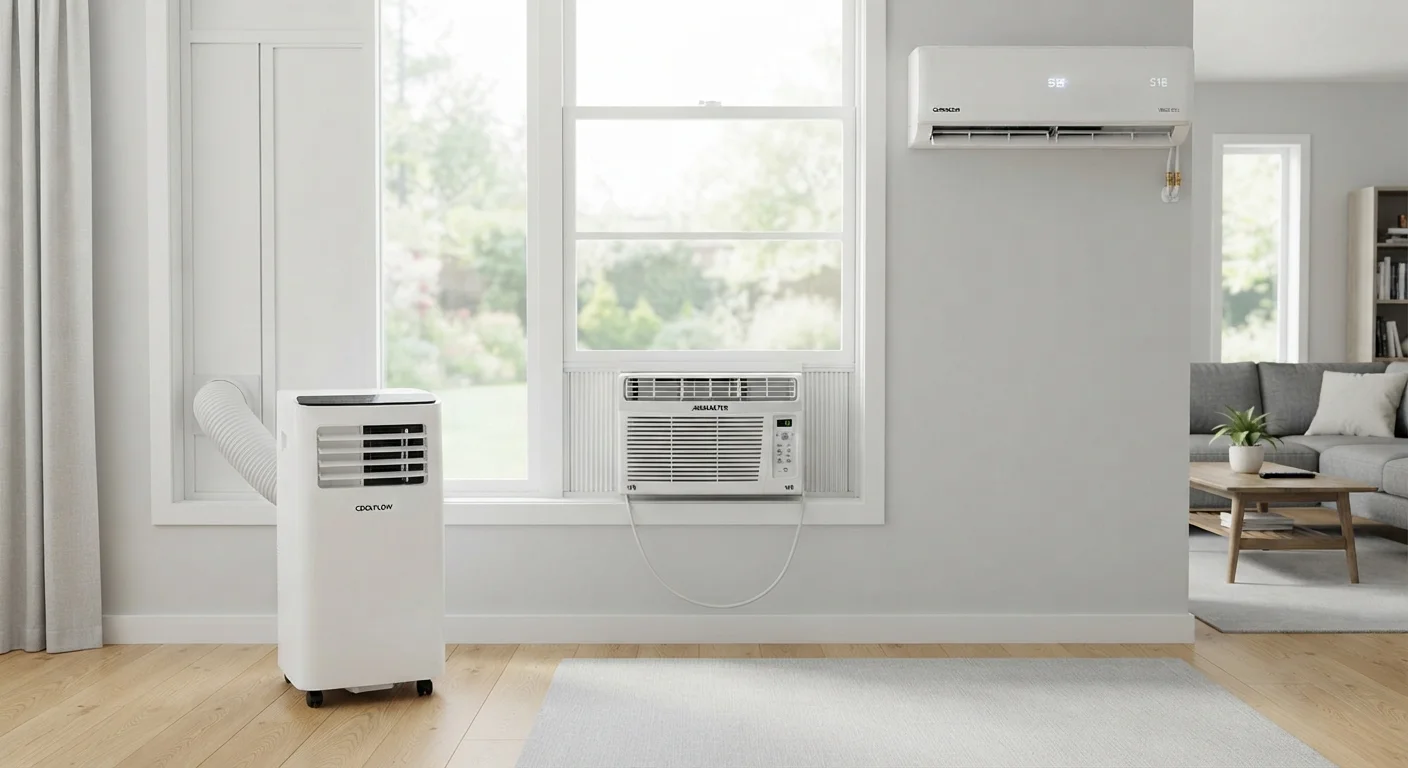
Portable ACs sit entirely inside the room and exhaust heat through a hose vented to a window - no mounting required. They move between rooms on caster wheels, which makes them appealing for renters or anyone in a building where window modifications aren't allowed.
The trade-off is efficiency. Because the unit sits in the conditioned space and generates heat as it operates, it works against itself to a degree. Portable units typically require more watts to produce the same cooling output as a comparably rated window unit. Noise is also a factor: the compressor is inside the room, not outside it.
Check Hose Design Before Buying Portable
Single-hose portable ACs draw air from inside the room to cool the compressor, then exhaust it outside - creating a slight negative pressure that pulls warm air in from elsewhere. Dual-hose models use a separate intake hose from outside, which avoids this problem. If you're comparing portable units on efficiency grounds, the hose configuration matters more than the BTU claim alone.
Single-hose models are common but less efficient than dual-hose designs, which pull intake air from outside rather than recycling conditioned room air. If efficiency matters, check which design a portable unit uses before comparing BTU claims.
Window Air Conditioners: The Single-Room Standard
Window units mount in a standard double-hung or sliding window frame, positioning the compressor outside and the evaporator inside. This split placement is what makes them meaningfully more efficient than portable units at the same BTU rating - heat rejection happens outside the room.
They're available across a wide BTU range, making it possible to match a unit closely to room square footage. Installation is manageable for most people without a contractor, though the unit's weight - often 50-80 lbs for mid-size models - can make window mounting a two-person job.
Window units do block the window they occupy and can be a security consideration on ground-floor installations. They're also seasonal: most homeowners remove them in winter, which adds annual setup and storage effort.
5,000-25,000
BTU range typical for window units
Window ACs span a wide output range, allowing relatively close matching to room square footage compared to most portable models.
~15-20%
Efficiency gap vs. portable units
The U.S. Department of Energy has noted that window ACs generally use less energy than portable units with equivalent rated cooling output.
Split Air Conditioners: Permanent, Quiet, and Efficient
Mini-split systems (also called ductless splits) use two components: an outdoor compressor unit and one or more indoor air handlers mounted on a wall. The two are connected by refrigerant lines routed through a small hole in the wall. This design keeps all mechanical noise outside and allows precise zone-by-zone temperature control with multi-zone configurations.
Energy efficiency is the strongest argument for splits. Many inverter-driven split systems carry SEER (Seasonal Energy Efficiency Ratio) ratings significantly higher than window or portable units. For homes in climates requiring extended cooling seasons, the operating cost difference can offset the higher upfront price over time.
The barrier is installation: running refrigerant lines requires an EPA-certified HVAC technician in the U.S., and installation costs typically range from several hundred to over a thousand dollars depending on complexity. This format is best suited to permanent living situations where long-term efficiency justifies the setup investment. The decision logic here isn't unlike choosing between fridge configurations - as covered in the refrigerator layout comparison, permanent appliance decisions involve trade-offs that extend well beyond sticker price.
Matching Format to Your Actual Situation
The right format depends on constraints that no BTU chart accounts for. Renters without window-modification rights are typically limited to portable units. Homeowners cooling a single room seasonally will usually find window units the most cost-effective path. Anyone investing in a primary residence and prioritizing long-term comfort and efficiency should give serious consideration to split systems, budget and installation access permitting.
Whatever format you're evaluating, confirm the BTU rating against your room's square footage - most manufacturers publish sizing guidance. Undersized units run continuously without reaching target temperature; oversized units cool too quickly without removing enough humidity, leaving rooms feeling clammy despite cool air. Format is the starting decision; sizing is what makes or breaks performance once you've narrowed it down.