Why Mattress Labels Are Hard to Read
Mattress marketing thrives on numbers that sound impressive but lack a universal standard. A "firmness rating of 6" from one brand may feel nothing like a 6 from another. Coil counts get inflated, foam densities get buried in fine print, and terms like "luxury" or "premium" carry no regulated meaning whatsoever. The result: shoppers pay for specs they can't verify and comfort claims that are essentially unenforceable.
This guide translates the most common mattress label terms into plain language, so you know which numbers actually predict comfort and durability - and which ones are mostly noise. If you've navigated similar confusion with bedding products, you may find our guide to bedding specs like thread count and fill power a useful companion read.
| Standard firmness scale | 1-10 (self-reported by brand; no industry standard) |
| Memory foam durability threshold | 3.0+ PCF for comfort layers |
| Support core foam minimum | 1.8 PCF (commonly cited benchmark) |
| Firm coil gauge range | 12-13 gauge |
| Soft coil gauge range | 14-15 gauge |
| "Orthopedic" label | Not a regulated or medically certified term |
Key Specs Decoded: Firmness, Foam Density, and Coil Count
Three specs appear on nearly every mattress label. Here's what each actually tells you:
Firmness Ratings
Most brands use a 1-10 scale, where 1 is ultra-soft and 10 is extra-firm. The problem is the scale is self-reported. There's no industry body that standardizes it. Generally, ratings 1-3 are soft, 4-6 are medium, and 7-10 are firm - but always try to find independent reviewer descriptions alongside any brand rating.
Foam Density (PCF)
Foam density is measured in pounds per cubic foot (PCF). This is one of the more reliable specs because it has a physical meaning: higher density foam uses more material per unit of volume, which typically correlates with longer durability. For memory foam comfort layers, 3 PCF or above is generally considered a durable grade. Support core foams are usually denser - 1.8 PCF or higher is a common minimum benchmark for quality. Lower-density foams compress and degrade faster.
Coil Count and Coil Gauge
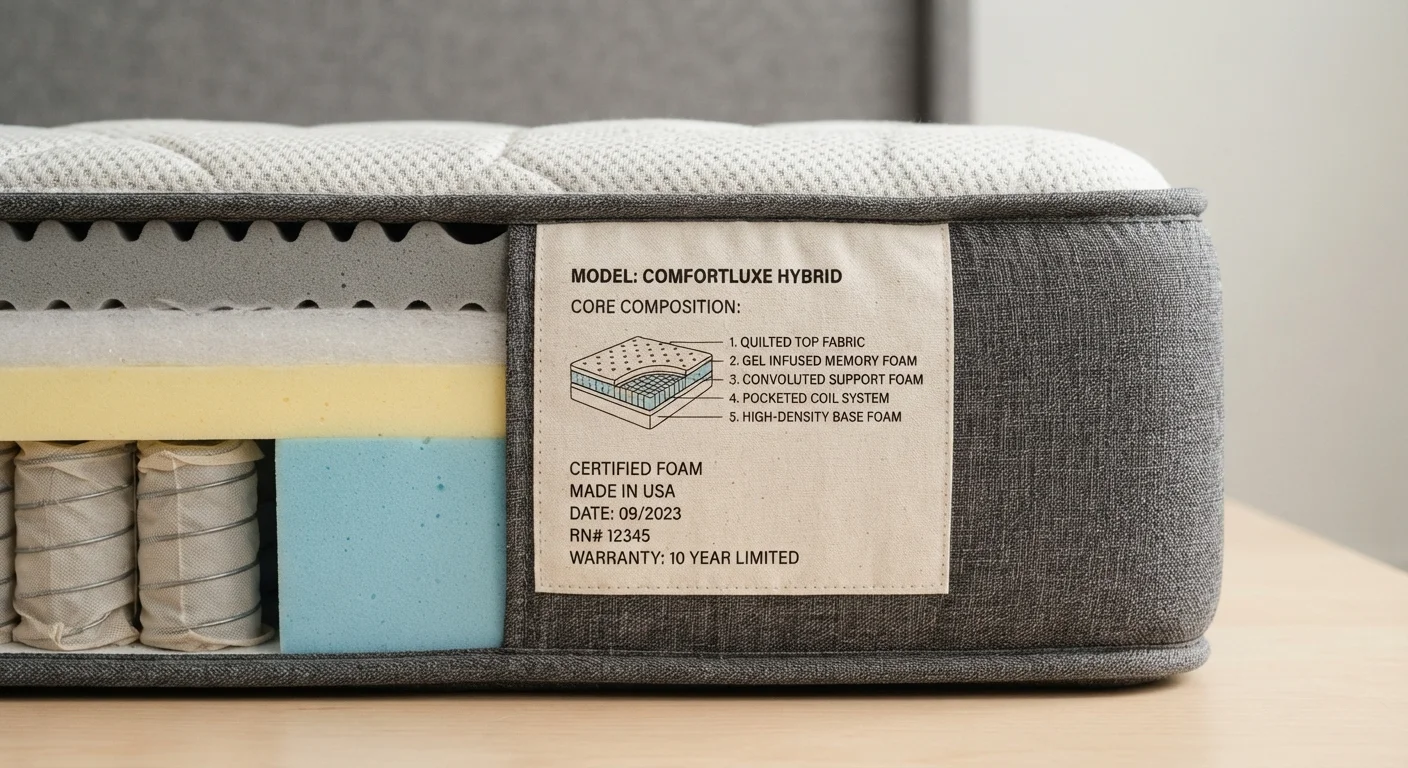
For innerspring and hybrid mattresses, coil count refers to the total number of springs. A higher count can mean better contouring and pressure distribution, but only up to a point - and only when compared within the same mattress size. A queen with 800 individually wrapped pocketed coils is typically more responsive than one with 400. Coil gauge measures the wire thickness: lower gauge numbers mean thicker, firmer wire. A gauge of 12-13 is firm; 14-15 is softer and more conforming.
PCF (Pounds Per Cubic Foot)
A measurement of foam density. It describes the weight of one cubic foot of foam material. Higher PCF values generally indicate more durable foam that holds its shape longer under repeated compression.
Coil Gauge
The thickness of the wire used to make mattress coils, measured on a numerical scale where lower numbers indicate thicker, firmer wire. Gauge affects how firm or soft a spring mattress feels.
Pocketed Coils
Individually fabric-wrapped springs that move independently of each other. This construction reduces motion transfer between sleep partners and allows the mattress to conform more precisely to body contours.
ILD (Indentation Load Deflection)
A standardized measurement of foam firmness. It records how many pounds of force are needed to compress a foam sample by 25% of its thickness. Higher ILD numbers mean firmer foam.
Phase-Change Material
A substance engineered to absorb and release heat at a specific temperature, used in some mattress covers and foam layers to moderate surface temperature during sleep.
GOLS Certification
Global Organic Latex Standard - a third-party certification verifying that latex used in a product meets defined organic content and processing requirements. Helps shoppers distinguish verified organic latex from unverified marketing claims.
Terms That Sound Technical but Aren't Standardized
Several words appear constantly on mattress labels without consistent, enforceable definitions:
- Orthopedic: Not a medically regulated term in the mattress industry. It does not mean a physician has evaluated or endorsed the product.
- Cooling technology: May refer to gel-infused foam, copper-infused foam, phase-change materials, or simply an open-cell foam structure. These do vary in effectiveness - ask for the specific mechanism, not just the label.
- Hybrid: Generally means a combination of coils and foam or latex layers, but the proportions vary widely. A mattress with a thin 1-inch foam layer over coils and one with 4 inches of foam over coils are both marketed as hybrids.
- Natural or organic: Look for third-party certifications (such as GOTS for organic textiles or GOLS for organic latex) rather than taking the claim at face value. Unverified "natural" language is common and loosely applied.
Third-Party Certifications Worth Checking
When a label uses terms like "organic," "natural," or "non-toxic," look for verification from recognized third parties: GOTS (Global Organic Textile Standard) for fabric, GOLS (Global Organic Latex Standard) for latex, and CertiPUR-US for foam. These programs have published criteria and audit requirements. A logo without a certifying body named alongside it is harder to verify.
Understanding what's in a product label is a useful skill across categories. The same principle of separating regulated terminology from marketing language applies when reading fabric composition labels on clothing.
How to Use These Specs When Shopping
No single spec determines whether a mattress will suit you. Use the following framework:
- Start with foam density if longevity is a priority. A comfort layer below 2.5 PCF in memory foam is likely to show body impressions within a few years.
- Cross-check firmness ratings with independent sources. Consumer review aggregators and editorial testers often describe feel more reliably than brand-assigned numbers.
- For hybrids and innersprings, look at coil type, not just count. Individually wrapped (pocketed) coils generally outperform Bonnell or offset coils for motion isolation and targeted support.
- Request material disclosure if it's not on the label. Retailers are generally able to provide spec sheets. If a brand can't confirm foam density or coil gauge, that absence of transparency is itself informative.
- Factor in the trial period and return policy. Because firmness is subjective and unlabeled standards vary, a meaningful in-home trial period gives you objective data no label can.
This article provides general consumer education about mattress labeling terminology and is not a substitute for hands-on product evaluation or professional advice tailored to specific health needs such as back or joint conditions. Consult a healthcare professional if you have medical requirements influencing your sleep surface choice.