What Each Tool Is Actually Designed to Do
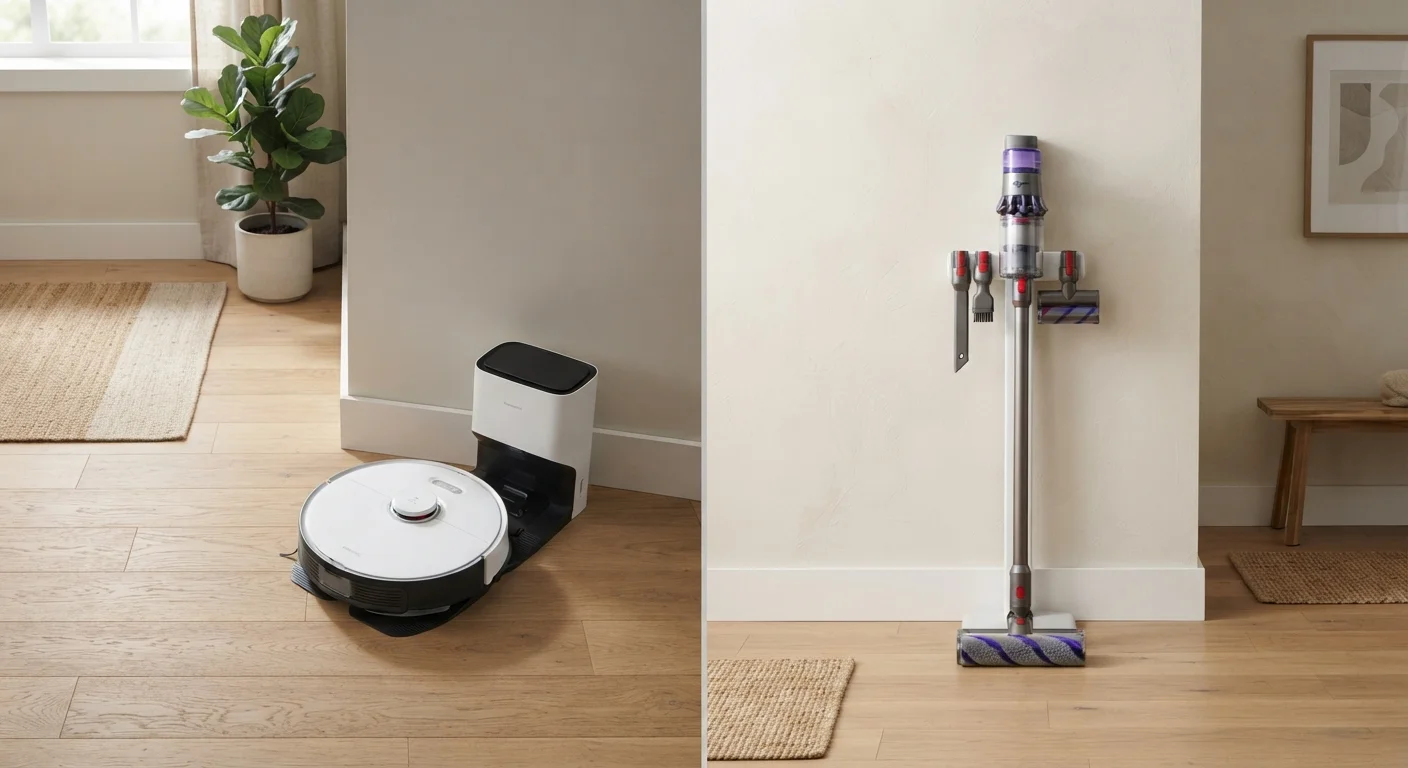
Before comparing specs, it helps to understand the design intent behind each format. A robot vacuum is built for frequency over intensity - it runs on a schedule, covering ground autonomously to prevent buildup. A stick vacuum is built for speed and reach - you grab it, clean a specific area, and put it away.
That distinction shapes every trade-off that follows. Neither format is universally better; they solve different problems. Before diving deeper, it's worth working through the questions worth asking before comparing any two home appliances to clarify what your household actually needs.
Robot vacuums use onboard sensors and, in higher-end models, laser mapping (LiDAR) or camera-based navigation to chart a room and avoid obstacles. They deposit dirt into a small onboard bin - or in self-emptying models, a base station. Stick vacuums, by contrast, use direct suction through a motorized floor head, powered by a rechargeable battery pack in cordless models. The operator controls direction, pressure, and surface selection.
Floor Plan Factors That Determine Fit
Your home's layout is often the deciding variable. Consider these floor plan realities:
- Open vs. cluttered rooms: Robot vacuums perform reliably in open spaces. Dense furniture arrangements with narrow gaps slow navigation and leave missed zones.
- Thresholds and rugs: Low-pile rugs are generally fine for robots. High-pile rugs and raised thresholds between rooms can stall or redirect them. Stick vacuums transition between surfaces instantly.
- Stairs: No robot vacuum climbs stairs. If your home has multiple levels, a stick vacuum is the only option for stair treads and landings.
- Room count and size: A robot works best when it can complete a full cycle without getting stuck. Very large homes may need a robot with strong battery capacity; very small homes may not justify the cost of a robot at all.
| Criterion | Robot Vacuum | Stick Vacuum |
|---|---|---|
| Operation | Autonomous, scheduled | Manual, on-demand |
| Stairs & multi-level homes | Not compatible | Fully compatible |
| Open floor plan performance | Excellent | Good |
| Tight corners & furniture edges | Varies by model | Strong with crevice tools |
| High-pile rug handling | Often limited | Generally capable |
| Typical purchase price range | Higher entry point | Wider range, lower floor |
| Ongoing maintenance complexity | Moderate to high | Low to moderate |
| Response to sudden messes | Scheduled; not immediate | Instant |
It's also worth noting that suction performance isn't determined by price tier alone. Our companion piece on why two vacuums with the same wattage can clean very differently breaks down what specs like Pa (pascals) and air watts actually reveal about real-world cleaning power.
Maintenance, Cost, and Daily Use Reality
Ownership costs extend beyond the purchase price. Robot vacuums require regular bin emptying (or a self-emptying base, which adds significant cost), brush roll cleaning, and filter replacement. Their navigation software may also need firmware updates. A tangled brush roll from long hair or pet fur is a common maintenance task owners underestimate.
Stick vacuums have simpler maintenance: empty the dustbin, clean the filter, and occasionally replace the filter or battery pack as it degrades over time. Battery lifespan - typically 300-500 charge cycles before capacity drops noticeably - is the primary long-term cost consideration for cordless models.
300-500
Charge cycles before battery capacity drops
Most lithium-ion battery packs in cordless vacuums show notable capacity reduction after this range of charge cycles, per general battery chemistry benchmarks.
~20-90 min
Typical robot vacuum battery runtime per charge
Runtime varies widely by model tier and suction setting; smaller homes generally fall within one charge cycle while larger homes may require mid-clean docking.
For households with pets, both formats have relevant trade-offs. Robot vacuums can run daily to manage shedding without you lifting a finger, which fits well into a broader pet care routine that actually sticks. Stick vacuums, however, typically offer stronger suction and specialized pet attachments for upholstery - something no robot can reach.
Can You Own Both? Many Households Do
Robot vacuums and stick vacuums aren't always an either-or decision. A common approach is to use a robot for daily maintenance on main-floor hard surfaces while keeping a stick vacuum for stairs, upholstery, and quick spot-cleaning. If budget allows both, they cover each other's blind spots effectively. If budget is a constraint, define your single biggest cleaning pain point first - that will tell you which format earns the spend.