Why Grain-Free Became a Pet Food Phenomenon
Walk down any pet store aisle and you will find grain-free foods prominently positioned as a premium, more natural choice. The implied message is straightforward: grains are filler, and removing them is better for your pet. That framing has proved enormously effective - grain-free products became a dominant category in the pet food market over the past decade.
But popularity is not the same as scientific validation. The grain-free trend tracks closely with human dietary fashions (notably low-carb and paleo eating), and much of its appeal stems from marketing that borrowed credibility from human nutrition without the supporting evidence for pets. Understanding where the claims come from - and what the research actually says - is essential for any owner trying to make a genuinely informed choice. For a practical foundation on decoding what goes into any pet food bag, our guide to reading pet food labels is a useful starting point.
Myth
Grains are just cheap filler with no nutritional value for pets.
Fact
Whole grains provide digestible carbohydrates, fiber, and micronutrients that can contribute meaningfully to a balanced diet.
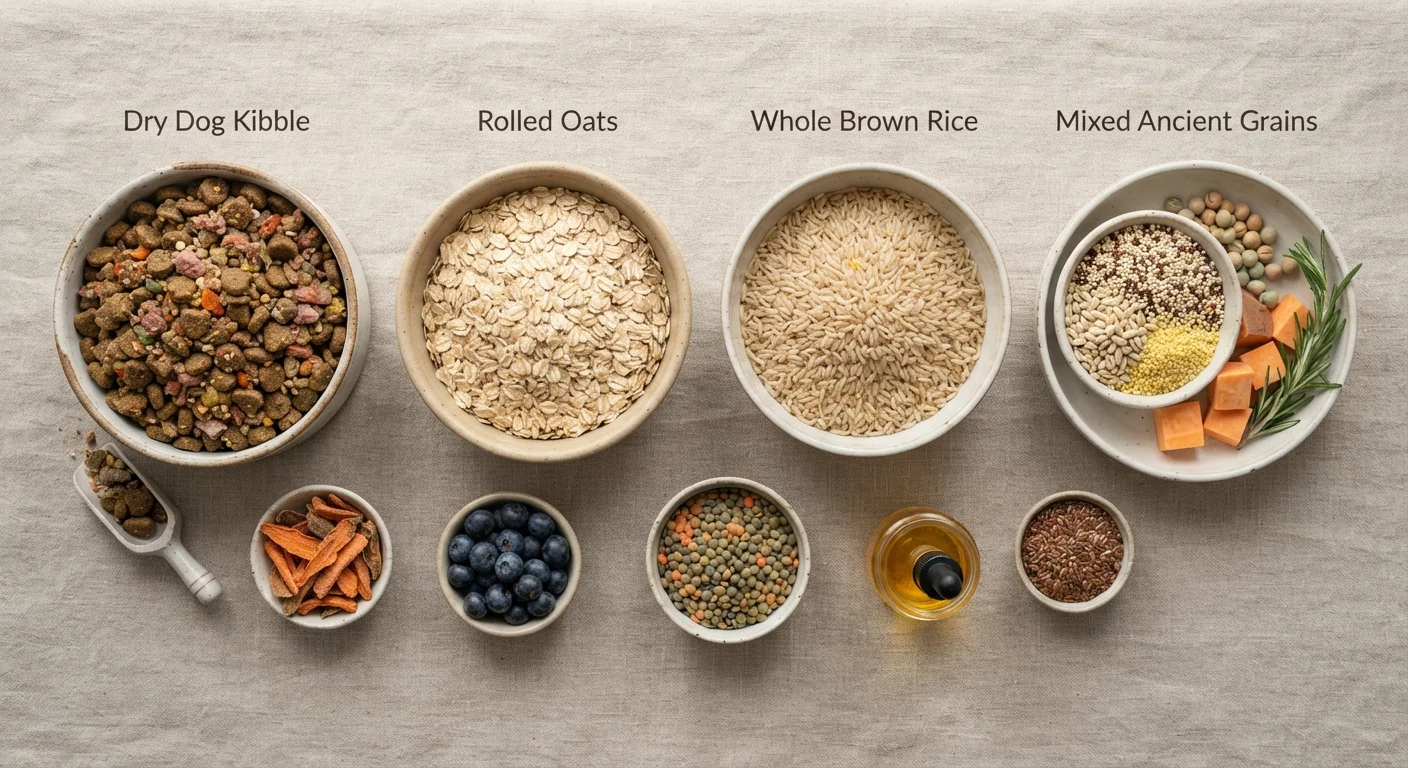
The word "filler" implies an ingredient added purely to bulk out a product without benefit. Whole grains such as brown rice, oatmeal, and barley are not that. They supply carbohydrates for energy, dietary fiber that supports digestive health, and B vitamins. Dogs, unlike cats, are omnivores with digestive systems well-adapted to processing carbohydrates. Studies on canine digestion show that cooked grains are highly digestible for dogs. The filler framing is a marketing construction, not a nutritional category.
Myth
Most dogs and cats are allergic or intolerant to grains.
Fact
True food allergies in pets are uncommon, and when they do occur, grains are rarely the culprit - proteins like beef and chicken are far more frequent triggers.
Food allergies in pets are often over-diagnosed by owners based on nonspecific symptoms such as loose stool or itching, which can have many causes unrelated to diet. Veterinary dermatology literature consistently identifies animal proteins - chicken, beef, dairy, and eggs - as the most common allergens in dogs, not grains. Wheat allergy exists but is genuinely rare. A proper food elimination trial under veterinary supervision is the only reliable way to identify a specific food sensitivity. Self-diagnosing a grain allergy and switching foods without this process often leads owners to spend more money without addressing the actual cause.
Myth
Wild ancestors of dogs and cats never ate grains, so grains are unnatural and harmful.
Fact
Domestic dogs have evolved alongside humans for thousands of years and have genetic adaptations that improve starch digestion compared to wolves.
The appeal to ancestral or "wild" diets is a recurring argument in pet food marketing, but it misrepresents both evolutionary biology and what modern domestic animals need. Research published in Nature identified that domestic dogs carry multiple copies of the AMY2B gene, which codes for an enzyme that helps digest starch - an adaptation not shared by wolves. Domestication fundamentally changed canine physiology. For cats, which are obligate carnivores, grain is less relevant nutritionally, but small amounts in a complete and balanced diet are not inherently harmful. The relevant question is always whether the overall diet meets the animal's nutritional requirements, not whether individual ingredients match an idealized ancestral template.
Myth
Grain-free means lower carbohydrates, which is healthier for all pets.
Fact
Grain-free diets frequently replace grains with other high-carbohydrate ingredients like potatoes, peas, and lentils, so total carbohydrate content may remain similar.
Removing grains does not automatically reduce carbohydrates in a kibble formula. Dry pet food requires a starch source to hold its shape during manufacturing. When grain is removed, manufacturers typically substitute legumes such as peas, chickpeas, or lentils, or starchy vegetables like sweet potatoes. These ingredients can have carbohydrate profiles comparable to the grains they replace. Beyond the FDA investigation's focus on legumes and cardiac risk, this substitution also means owners paying a premium for "grain-free" may not be getting the low-carbohydrate product they imagine. Reading the full ingredient list and guaranteed analysis matters more than a front-of-bag claim.
The FDA Investigation and Cardiac Risk in Dogs
One of the most significant developments in pet nutrition science over recent years was a formal investigation by the U.S. Food and Drug Administration (FDA) into a potential association between grain-free diets and dilated cardiomyopathy (DCM) - a serious heart condition - in dogs. The investigation, launched in 2018, identified reports of DCM in breeds not typically predisposed to the condition, and a notable proportion of affected dogs had been eating legume-heavy, grain-free diets.
FDA Investigation Into Grain-Free Diets and Heart Disease
The FDA has been investigating a potential link between certain grain-free dog foods and dilated cardiomyopathy (DCM), a serious and potentially fatal heart condition. While a confirmed causal relationship has not been established, the agency has recommended that pet owners consult their veterinarian if their dog is eating a grain-free diet, particularly one high in peas, lentils, or legume seeds. Do not make abrupt dietary changes without professional guidance.
Researchers suspect the connection may involve taurine metabolism, the high proportion of legumes such as peas and lentils used as grain substitutes, or other formulation factors - but a definitive causal mechanism had not been established as of the investigation's most recent public updates. The science remains active and unsettled. What is clear is that the theoretical benefits of avoiding grains were never tested against this kind of risk before grain-free diets became mainstream. If your dog eats a grain-free diet, discuss this with your veterinarian rather than making abrupt changes on your own.
77%
DCM cases involving legume-rich diets
According to the FDA's 2019 update on its DCM investigation, approximately 77% of reported dog food products associated with cases were grain-free and contained peas or lentils as a primary ingredient.
1-2%
Estimated prevalence of true food allergies in dogs
Veterinary dermatology sources estimate that genuine food allergies affect a small minority of the dog population, with environmental allergens being a far more common cause of skin and coat problems.
Owners of cats should also note that feline nutritional needs differ substantially from dogs - for a species-specific breakdown, see our article on why cats are not small dogs.
Making a Practical Decision for Your Pet and Budget
For most healthy dogs and cats, a grain-inclusive diet that meets AAFCO (Association of American Feed Control Officials) nutritional standards for their life stage is a nutritionally sound choice. Grains such as rice, oats, and barley are digestible energy sources and do not pose a health risk to animals without a confirmed grain sensitivity - a condition your veterinarian can evaluate if you have genuine concerns.
If your pet has been thriving on its current diet with no digestive upset, skin issues, or coat changes, there is generally no evidence-based reason to switch to grain-free. Budget-conscious owners should also know that grain-free formulas typically cost more than comparable grain-inclusive options, and that premium pricing rarely correlates directly with nutritional superiority. For strategies on feeding well without overspending, our article on stretching your pet food budget covers practical approaches.
The most reliable guide to your individual pet's dietary needs is a licensed veterinarian or board-certified veterinary nutritionist - not packaging claims. A broader look at misconceptions that come up in practice is covered in our article on pet nutrition myths veterinarians hear all the time.
This article is for general informational purposes only and does not constitute veterinary or medical advice. Always consult a qualified veterinarian before making changes to your pet's diet, especially if your pet has an existing health condition.