What This Workout Plan Covers
Gym memberships and home equipment aren't prerequisites for getting stronger, more mobile, or more cardiovascularly fit. This plan uses only your bodyweight and a patch of floor roughly the size of a yoga mat - around 6 feet by 2 feet. It targets all major muscle groups across three structured workout days per week, with built-in progressions so you're never stuck at the same difficulty level for long.
If you're just getting started, see our guide to building a home routine from scratch for context on structuring your week. And if you want to optimize your environment before you begin, our article on setting up a home workout space without spending much has practical, low-cost tips.
What you will need
The Full-Body Workout Plan: Step by Step
Follow the steps below in order each session. Aim for three non-consecutive days per week - for example, Monday, Wednesday, and Friday - to allow for adequate recovery between sessions.
Warm Up (5-7 minutes)
Never skip the warm-up. Spend 5-7 minutes raising your heart rate and loosening your joints before any strength or cardio work. A reliable sequence:
- 30 seconds of marching in place
- 10 arm circles each direction
- 10 hip circles each direction
- 10 leg swings per leg (front-to-back, then side-to-side)
- 10 bodyweight squats at a slow, controlled pace
- 10 shoulder rolls
Lower Body: Squats and Glute Bridges
Perform 3 sets of each exercise with 60 seconds of rest between sets.
- Bodyweight Squat
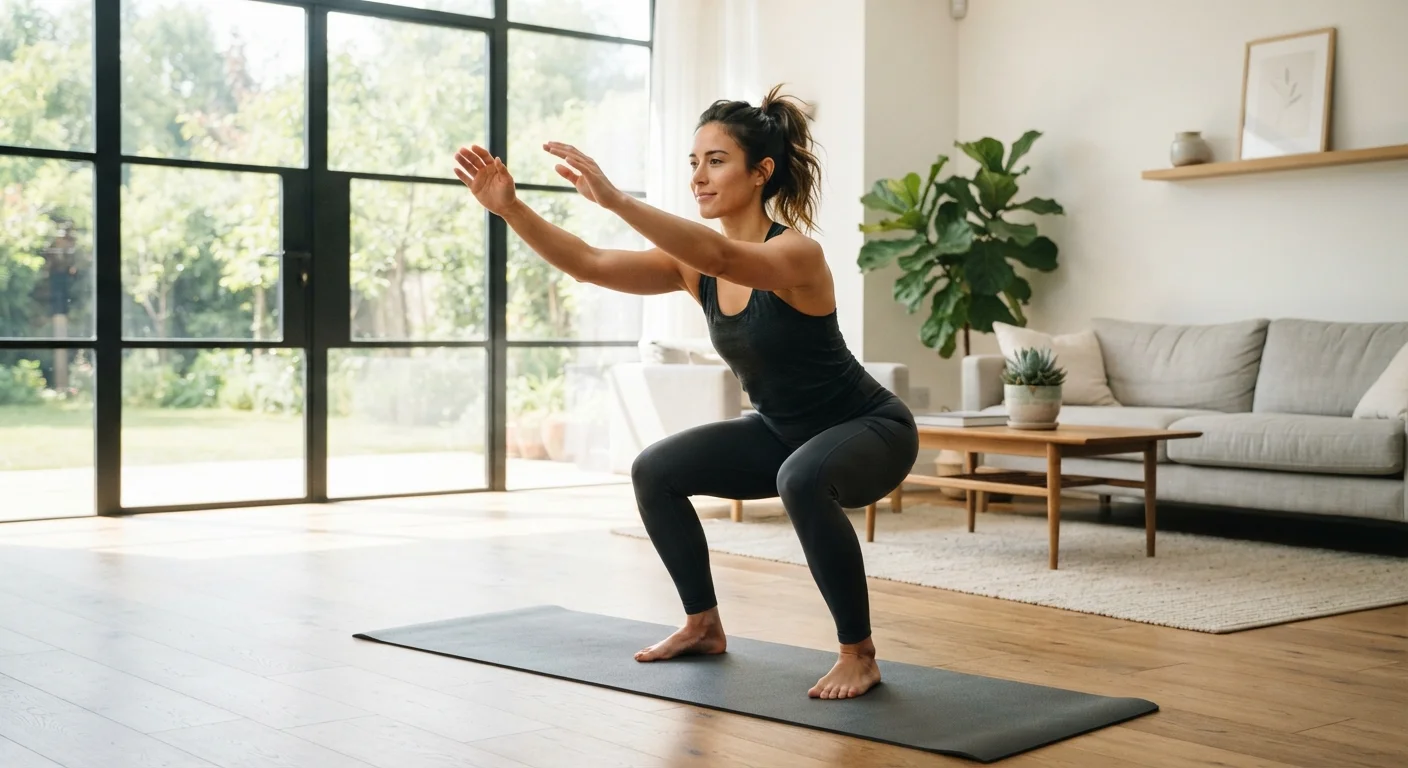
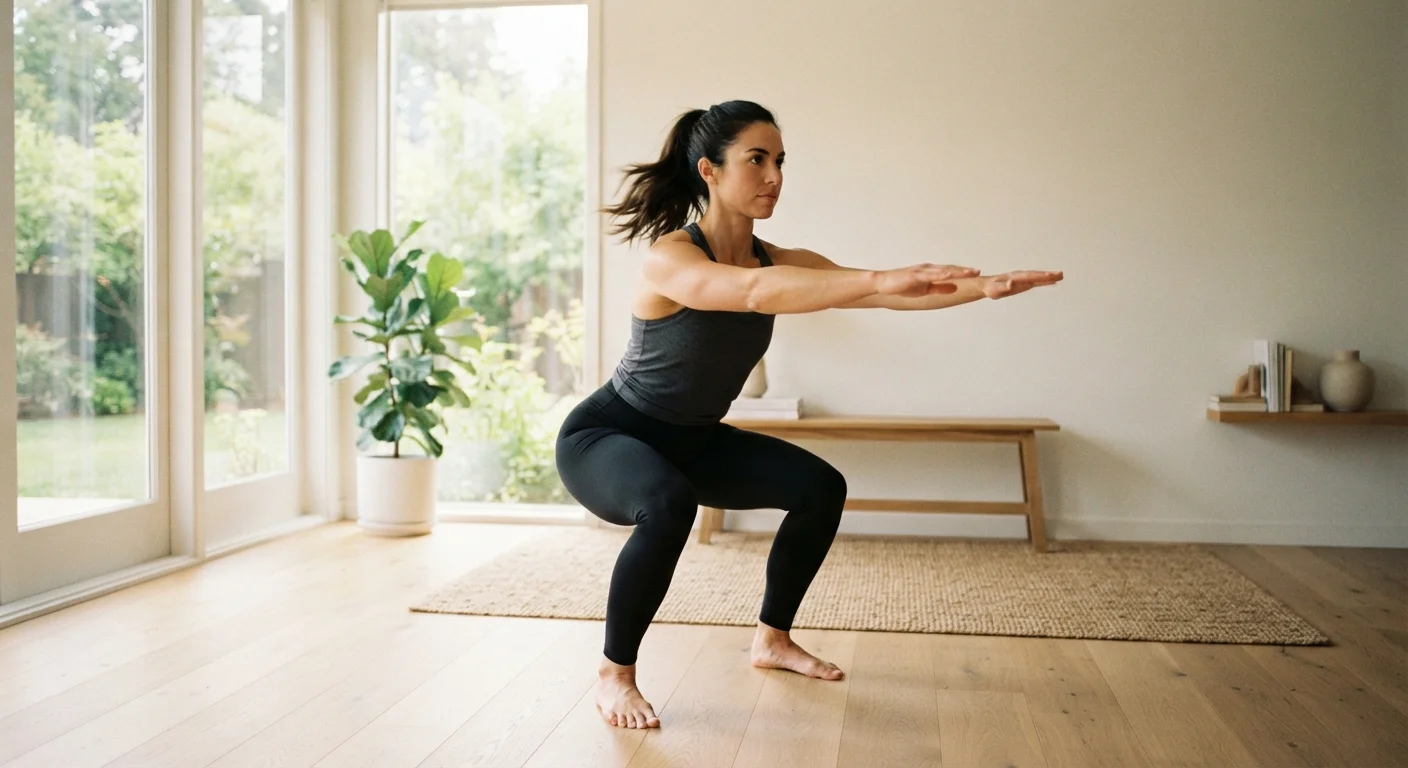
- Stand feet shoulder-width apart, toes slightly out. Lower until thighs are parallel to the floor (or as low as is comfortable), keeping your chest up and knees tracking over your toes. Drive through your heels to stand. Target: 12-15 reps per set. Beginner modification: squat to a chair seat and stand back up.
- Glute Bridge
- Lie on your back, knees bent, feet flat on the floor hip-width apart. Press your heels down and raise your hips until your body forms a straight line from shoulders to knees. Squeeze at the top, hold for 2 seconds, then lower. Target: 15 reps per set.
Upper Body: Push-Ups and Plank Shoulder Taps
Perform 3 sets of each exercise with 60 seconds of rest between sets.
- Push-Up
- Start in a high plank position: hands slightly wider than shoulder-width, body in a straight line from head to heels. Lower your chest toward the floor, elbows at roughly a 45-degree angle from your torso, then press back up. Target: 8-12 reps per set. Beginner modification: perform from the knees, keeping hips in line with the rest of the body.
- Plank Shoulder Tap
- Hold a high plank. Keeping hips as still as possible, lift one hand and tap the opposite shoulder, then alternate. Target: 10 taps per side per set.
Core: Dead Bug and Bicycle Crunch
Perform 2-3 sets of each exercise with 45-60 seconds of rest between sets.
- Dead Bug
- Lie on your back, arms pointed straight toward the ceiling, knees bent at 90 degrees above your hips. Keeping your lower back pressed to the floor, slowly lower your right arm overhead while extending your left leg. Return to start, then alternate sides. Target: 8 reps per side per set.
- Bicycle Crunch
- Lie on your back, hands lightly behind your head, knees bent. Bring one knee toward your chest while rotating your opposite shoulder toward it, then alternate in a controlled, cycling motion. Target: 12 reps per side per set.
Cardio Burst: High Knees or Low-Impact March (3 minutes)
Finish the strength work with a brief cardio burst to elevate heart rate and build endurance. Choose based on your current fitness level and any joint considerations:
- High Knees: Run in place, driving your knees up toward hip height. Pump your arms. Perform for 30 seconds on, 15 seconds rest, repeated 4 times.
- Low-Impact March: March in place, lifting knees as high as comfortably possible and swinging arms deliberately. Same interval format as above.
Cool Down and Stretch (5 minutes)
Bring your heart rate down gradually and stretch the muscles you've worked. Hold each stretch for 20-30 seconds without bouncing.
- Child's Pose - stretches lower back, hips, and shoulders
- Supine Figure-4 Stretch - targets glutes and outer hips (lying on your back, cross one ankle over the opposite knee and gently pull the thigh toward you)
- Doorway or Floor Chest Stretch - opens the chest after push-up work
- Seated Forward Fold - stretches hamstrings and lower back
- Neck Side Stretch - releases tension in the upper traps
Track Your Sessions Simply
Write down the exercises, sets, and reps you complete after each session - even a basic notes app works. This record makes it easy to spot when you're ready to progress and helps you stay consistent. See our article on exercise consistency strategies for habit-building approaches that keep workouts sustainable long term.
Progressions and Troubleshooting
Once any exercise feels manageable for all listed reps across three sessions, apply one of these progression strategies:
- Add reps: Increase by 2-5 reps per set.
- Slow the tempo: Lower in 3-4 counts, pause at the bottom, rise in 2 counts.
- Advance the variation: Move from knee push-ups to standard, then to pike push-ups. Swap squats for jump squats. Try single-leg glute bridges.
- Reduce rest: Shorten rest periods from 60 seconds to 40 seconds between sets.
If progress stalls despite consistent effort, our article on why home workouts stall and what to do about it explains common causes and practical fixes. For scaling guidance specific to your fitness level, see Home Fitness for Every Stage.
Don't Skip Rest Days
Muscle repair and strength development happen during recovery, not during the workout itself. Training the same muscle groups daily without adequate rest can lead to overuse injuries and stalled progress. Stick to three non-consecutive days per week, and treat rest days as a deliberate part of your plan.
This article is for general informational and educational purposes only and is not a substitute for professional medical advice. Consult a qualified healthcare provider before beginning any new exercise program, especially if you have an existing health condition, injury, or have been inactive for an extended period.