Why Adapting Your Workout Matters
Home fitness works best when your workouts match your actual capabilities - not the idealized version of yourself you hope to be next month. Training too hard too soon invites injury and burnout. Training too easy produces stagnation. The sweet spot is a program that challenges you just enough to stimulate adaptation without overwhelming your body's recovery capacity.
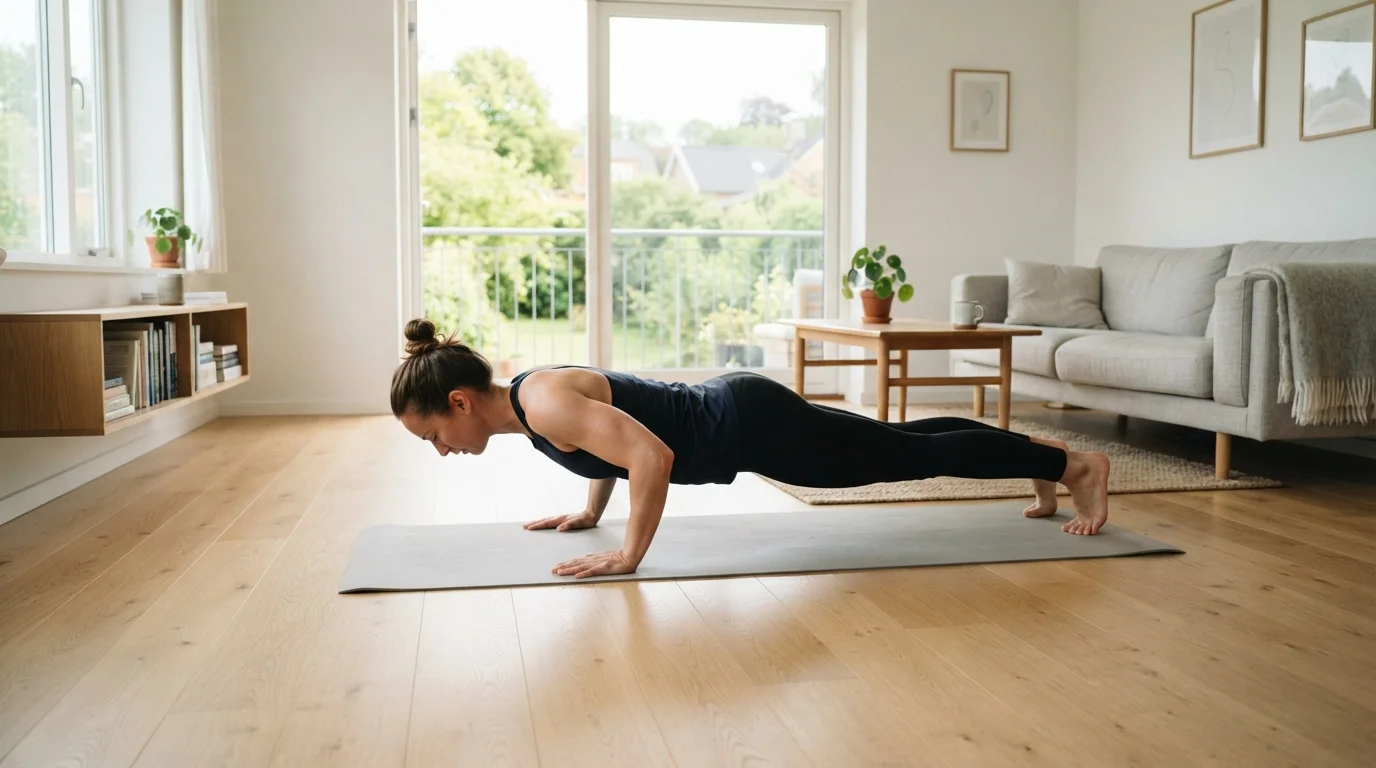
The good news: bodyweight exercise is one of the most scalable training tools available. A push-up can be performed from a wall, a countertop, the floor, or with feet elevated - each variation demands progressively more from the same muscles. Understanding these progressions is what separates a frustrating plateau from steady, satisfying improvement.
Many people assume home fitness is a temporary workaround until they can afford a gym membership. In reality, as home fitness research consistently shows, bodyweight training alone can build real strength, cardiovascular fitness, and mobility across a lifetime - provided the workouts evolve alongside the person doing them.
73%
Adults who prefer exercising at home
A survey by the International Health, Racquet & Sportsclub Association found nearly three-quarters of respondents cited convenience as their primary reason for home-based exercise.
8-12 weeks
Time for beginners to see measurable strength gains
Exercise physiology research consistently shows that untrained individuals typically experience noticeable strength improvements within 8-12 weeks of consistent training.
2-3x
Injury risk reduction with proper warm-up
Public health exercise guidelines note that structured warm-ups can meaningfully reduce soft-tissue injury risk compared to exercising cold.
Getting Started: The Beginner Stage
If you are new to structured exercise, returning after a long break, or managing a health condition, the beginner stage is your foundation. The goal here is not intensity - it is movement quality, consistency, and building the connective tissue resilience that supports harder training later.
What beginner home workouts should include
- Low-impact movement: Walking in place, step-touches, and gentle marching protect joints while elevating heart rate. See our guide on low-impact home workouts for a fuller breakdown of qualifying movements.
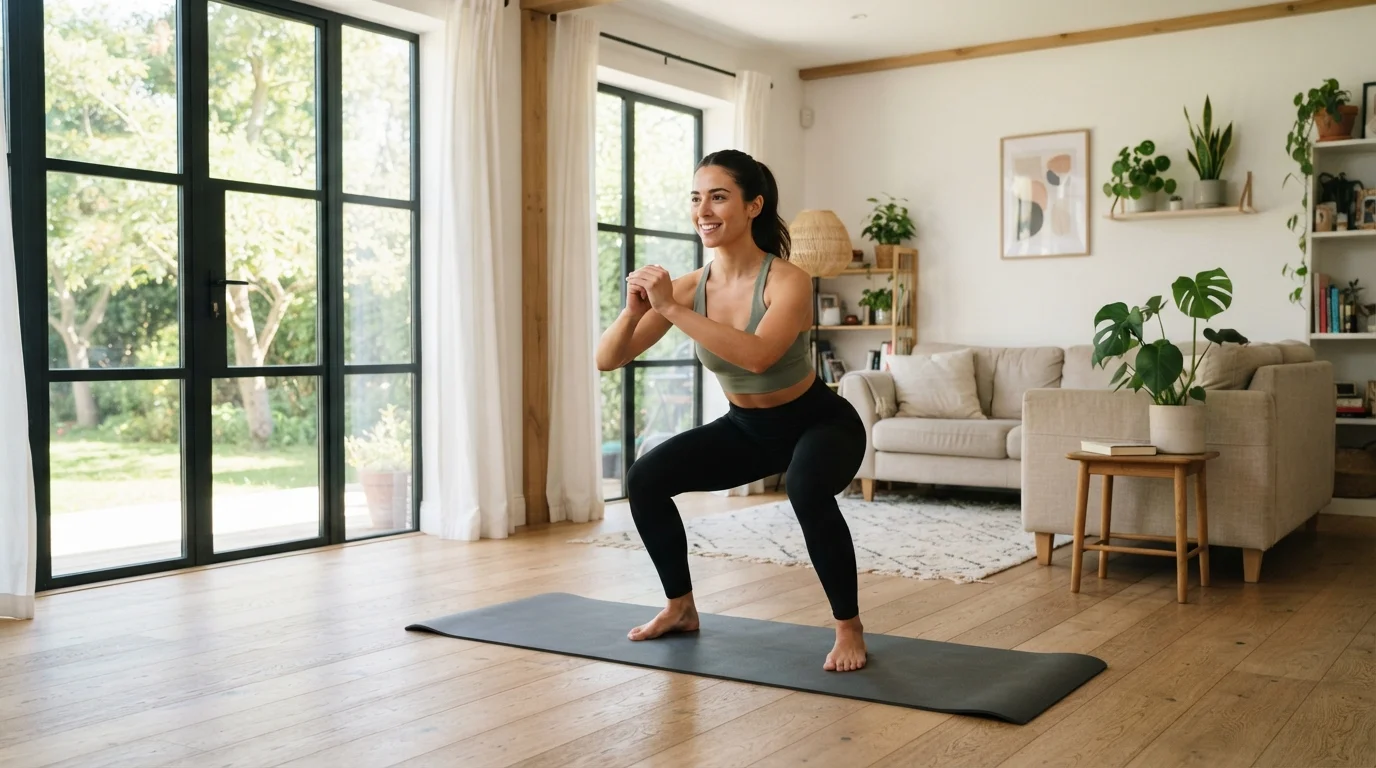
- Supported strength exercises: Wall push-ups, chair-assisted squats, and countertop rows allow you to load muscles without demanding full bodyweight control.
- Short sessions: Three to four sessions of 15-20 minutes per week is a realistic and productive starting point.
- Deliberate warm-ups: A brief mobility warm-up before each session significantly reduces injury risk. Our article on warming up and cooling down outlines exactly what to include.
Start With Movement, Not Intensity
In the beginner stage, your primary job is to show up consistently and move without pain. Resist the urge to push hard in early sessions - early soreness can discourage the consistency that actually produces results. Build the habit first, then build the intensity.
Readiness to progress: when you can complete your planned sets with good form and feel recovered within 24 hours, it is time to gently increase difficulty.
This article is for general informational purposes only and does not constitute medical advice. If you have a health condition, injury, or are new to physical activity, consult a qualified healthcare professional before beginning any exercise program.
Building Momentum: The Intermediate Stage
Once foundational movement patterns feel stable - squats, hinges, pushes, pulls, and carries - you are ready to increase challenge without adding equipment. At the intermediate stage, the focus shifts from learning movements to accumulating volume and refining control.
Key intermediate strategies
- Full range of motion: Transition from partial to full-depth squats and push-ups from the floor rather than an elevated surface.
- Tempo manipulation: Slowing the lowering phase of any exercise (a 3-4 second descent) dramatically increases muscular demand with zero added load.
- Superset pairings: Alternating between opposing muscle groups - push-ups followed immediately by a bodyweight row using a low table edge - increases workout density and cardiovascular demand.
- Volume progression: Add one or two repetitions per set each week rather than jumping to harder variations too quickly.
The concept of progressive overload without weights is the engine of intermediate progress. Tempo, leverage, and volume are your primary tools.
Before jumping to a harder exercise variation, try adding one slow-tempo set to your current variation. A 4-second lowering phase on a standard push-up is often more productive than rushing to an archer push-up with poor control.
Controlled eccentric loading builds tendon resilience and muscular endurance that supports safe progression to advanced movements.
Log not just what you did, but how it felt. 'Felt easy by set 3' is a reliable signal to increase reps or slow tempo next session.
Subjective effort tracking alongside rep counts gives a fuller picture of readiness to progress than numbers alone.
Pushing Further: The Advanced Stage
Advanced home fitness is not about doing more - it is about doing harder. At this stage, standard push-ups and air squats no longer create meaningful challenge, so exercise selection and structure must shift accordingly.
Advanced progressions to explore
- Leverage-based progressions: Archer push-ups, single-leg Romanian deadlifts, and Bulgarian split squats shift more load onto one limb, multiplying difficulty without equipment.
- Plyometric additions: Jump squats, clap push-ups, and explosive step-ups add power training that challenges the neuromuscular system differently than slow strength work.
- Skill-based movements: Handstand progressions, L-sit holds, and pike push-ups require significant body control and take weeks or months to develop safely.
- Structured weekly planning: Advanced trainees benefit most from deliberate recovery management. The framework in our guide on balancing a week of home workouts applies directly here.
Know When to Consult a Professional
Pain that is sharp, joint-specific, or persists after a workout is not normal soreness - it is a signal to stop and seek evaluation from a qualified healthcare provider or physical therapist. Training through genuine pain can convert a minor issue into a lasting injury. When in doubt, rest and get assessed before continuing.
If progress stalls at this stage, the solution is rarely more volume - it is usually smarter structure. Our article on why home workouts stall addresses the most common causes.
Adapting for Special Circumstances
Fitness levels are not only defined by athletic experience. Pregnancy, injury recovery, chronic pain, older age, and long periods of inactivity all require thoughtful modification regardless of previous fitness history.
- Post-injury or chronic pain: Return-to-exercise timelines vary by condition and individual. Always follow guidance from a physical therapist or physician before resuming training after injury. Movement quality and pain-free range of motion take absolute priority over intensity.
- Older adults: Balance, joint mobility, and muscle maintenance become increasingly important with age. Slower tempos, unilateral exercises, and floor-to-stand practice address these priorities well.
- Pregnancy and postpartum: Exercise guidelines during and after pregnancy are specific to the individual's health status and stage. Consult a qualified healthcare provider for personalized guidance.
- Extended inactivity: Treat a return to training like a beginner phase regardless of past fitness. A few weeks of patience now prevents months of setback from overuse injury.
For a practical no-equipment plan applicable across these circumstances, see our full-body home workout plan for clear, level-appropriate progressions.
Tracking Progress Without a Gym
Without barbells or machines, progress can feel invisible - but it is measurable. Shifting your attention from weight lifted to movement quality, recovery speed, and workout capacity reveals steady improvement over time.
Practical progress markers
- Rep quality
- Can you perform the same number of reps with better control and fuller range than last month? That is measurable progress.
- Recovery rate
- If the same workout leaves you less sore and fatigued than it did six weeks ago, your body has adapted - a sign it is time to increase challenge.
- Workout density
- Completing the same exercises in less time, or more work in the same time, is a direct indicator of improved fitness.
- Subjective effort
- Movements that once felt difficult becoming routine is a meaningful sign of progress, even without numerical data.
Building the habit of logging sessions - even a simple note of exercises, sets, and how you felt - creates the feedback loop that keeps progress deliberate. For strategies on sustaining that consistency, see our guide on exercise consistency at home.
“The best exercise program is the one that matches where you are right now - not where you were, and not where you want to be. Meeting yourself honestly at each stage is what makes progress sustainable.”
— American College of Sports Medicine, Leading professional organization for exercise science and sports medicine