
Why Unfamiliar Products Are Harder to Compare Fairly
When you've never owned either product you're evaluating, you have no personal baseline - no intuitive sense of whether a spec is meaningful or a feature is actually useful in practice. That gap is exactly what marketing is designed to exploit. Vivid photography, aspirational copy, and cherry-picked user quotes fill the vacuum that experience would otherwise occupy.
The result is that most shoppers default to two unreliable shortcuts: price as a quality proxy, or brand reputation as a stand-in for product fitness. Both can mislead. A higher price reflects many things besides quality - distribution costs, branding investment, retailer margin. Brand reputation is a lagging indicator built on past products that may share little with the current model you're evaluating.
A structured comparison process replaces those shortcuts with criteria you control. It won't tell you how a product feels to use - nothing short of hands-on experience does that - but it will make the trade-offs visible and anchored to your specific situation. See also what habits make product comparisons less useful to understand the patterns this method is designed to avoid.
Flip the Frame: Start With Dealbreakers
Before scoring anything, list two or three absolute dealbreakers - dimensions that won't fit, materials you can't use, features that are non-negotiable. Any product that fails a dealbreaker criterion is out regardless of its overall score. This shortcut can eliminate an option before you invest significant research time.
What You'll Need Before You Start
A fair comparison requires a few inputs before you open any product page. Gathering them upfront prevents the most common failure mode: letting product listings shape your criteria instead of the other way around.
What you will need
Spreadsheet or comparison table
Records criteria and scores side by side so you can see gaps at a glance.
Manufacturer spec sheets
Provides verified technical details that retailer listings sometimes omit or misstate.
Owner forums or community Q&A threads
Surfaces real-world performance issues and use-case limitations not visible in specs.
Unit conversion tool
Ensures dimensions, weights, and capacities are compared in the same units.
The Step-by-Step Comparison Process
Follow these steps in order. The sequence matters: each step is designed to insulate your judgment from the biases introduced by the previous information source. Skipping ahead - especially to pricing before your criteria are set - undermines the whole approach.
Write down your use case before researching
Before opening a single product page, write one or two sentences describing exactly what you need the product to do, in what environment, and how often. This statement becomes your anchor. Every feature you evaluate later should connect back to it.
For example: "I need a countertop air fryer that can cook a full chicken, fits under a 16-inch cabinet, and is easy to clean after daily use." That description already rules out certain capacity ranges, heights, and basket designs - before marketing language enters the picture.
Build a criteria list with defined weights
List every attribute that matters to your use case - capacity, dimensions, material quality, ease of cleaning, warranty length, noise level, or whatever applies. Then assign each criterion a weight from 1 to 3 based on how much it affects your decision.
Weighting forces you to decide in advance what matters most, so that a single impressive spec on one product doesn't crowd out a dozen more relevant factors. This is the step most shoppers skip - and it's why they end up with buyer's remorse.
Pull specs from primary sources, not just retailer listings
Retailer product pages are written to sell, not to inform. They may round numbers, omit unflattering specs, or use ambiguous terms like "heavy duty" without definition. Go directly to manufacturer spec sheets, user manuals, or regulatory filings for the authoritative figures.
For each criterion on your list, record the exact spec for both products in the same unit of measurement. This is where a spreadsheet pays off - you can spot gaps immediately when one column is blank. See our guide to aligning specs across retailer sites for tactics on dealing with inconsistent formatting.
Cross-check with owner communities and independent tests
Spec sheets describe what a product is rated to do under controlled conditions. Owner forums, subreddit threads, and independent lab tests describe what it actually does under everyday conditions. Search for threads where owners discuss the product after extended use - not first-impression posts from the week of purchase.
Look specifically for recurring complaints, not isolated ones. A single report of a broken part may be an outlier; a pattern of the same failure mode across multiple owners is a structural issue. Reading reviews critically means filtering for specificity, verified purchase status, and recency.
Score each product against your weighted criteria
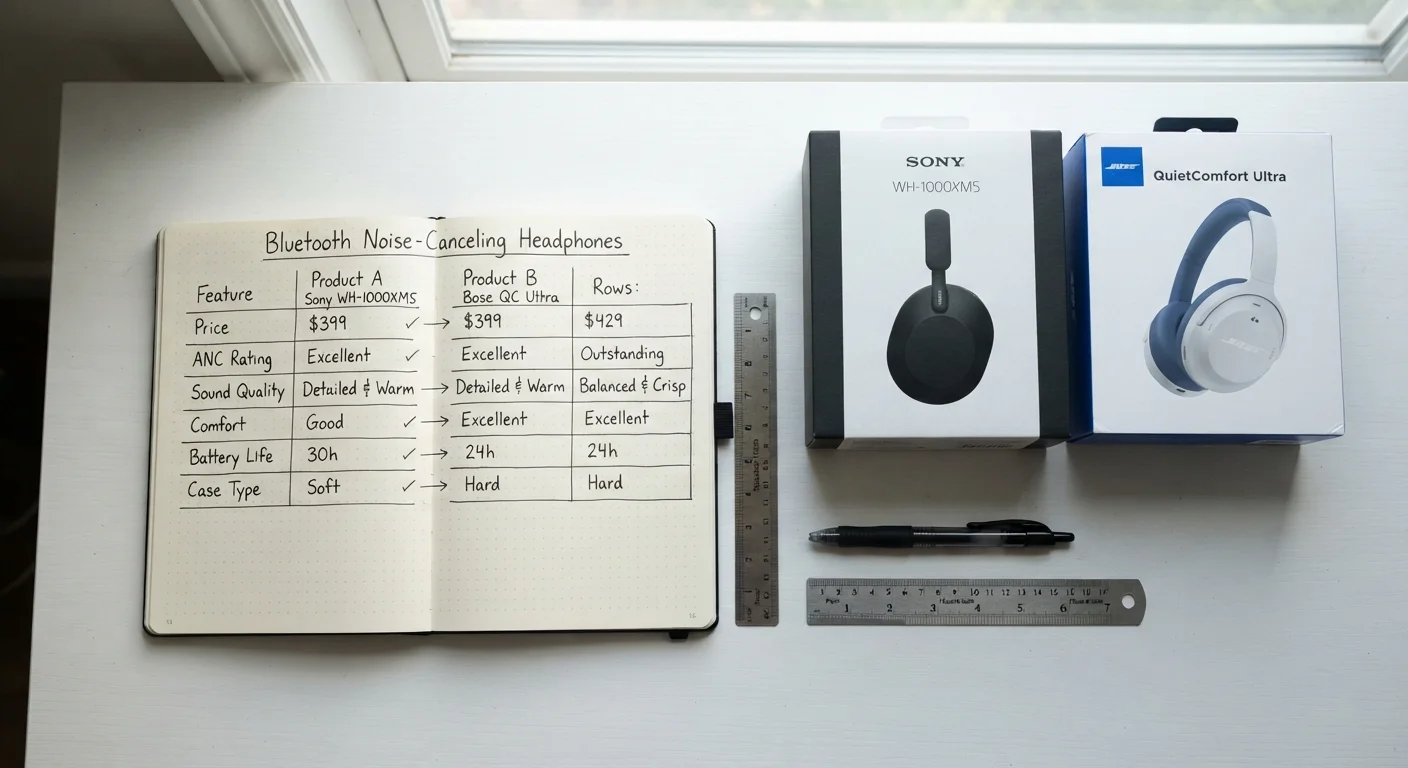
Score both products on each criterion using a simple 1-5 scale, then multiply each score by its weight. Total the weighted scores for each product. This gives you a number that reflects your priorities - not a generic ranking someone else built for a different audience.
The goal isn't a definitive verdict from the math alone. It's a structured way to surface where the trade-offs actually live. If Product A wins on performance but loses on dimensions, that gap is visible rather than buried in a wall of marketing copy.
Run a price-per-priority check before deciding
Look at the price difference between the two products and ask: what does the extra cost actually buy you, relative to the criteria you weighted highest? If the pricier option wins only on criteria you weighted low, the premium isn't justified for your use case - even if it's genuinely the more capable product overall.
This check also helps you resist the pull of features you'll never use. A higher-end product may be objectively better on paper; that doesn't mean it's the right match for your specific situation. For a broader view of how to manage multiple options at once, see our comparison shopping organizational approach.
Marketing Language Is Not a Specification
Terms like "professional grade," "military strength," or "ultra-quiet" are not standardized and carry no enforceable meaning. Never record these phrases in your criteria table as if they are measurable specs. Require a number, a standard, or a verifiable third-party rating before treating a claim as evidence.
Your Use Case Overrides Every Review
A product with thousands of positive reviews may still be the wrong choice for your specific environment, frequency of use, or physical constraints. Aggregate ratings reflect an average user - not you. The structured criteria process exists precisely to correct for this mismatch, so don't abandon your weighted score because of social proof alone.