Why One Word Carries So Much Weight
Cosmetic ingredient lists in the U.S. follow a fairly logical system: ingredients are ranked by concentration, INCI (International Nomenclature of Cosmetic Ingredients) names are standardized, and the list is meant to give you a clear picture of what you're applying to your skin. Except for one glaring exception.
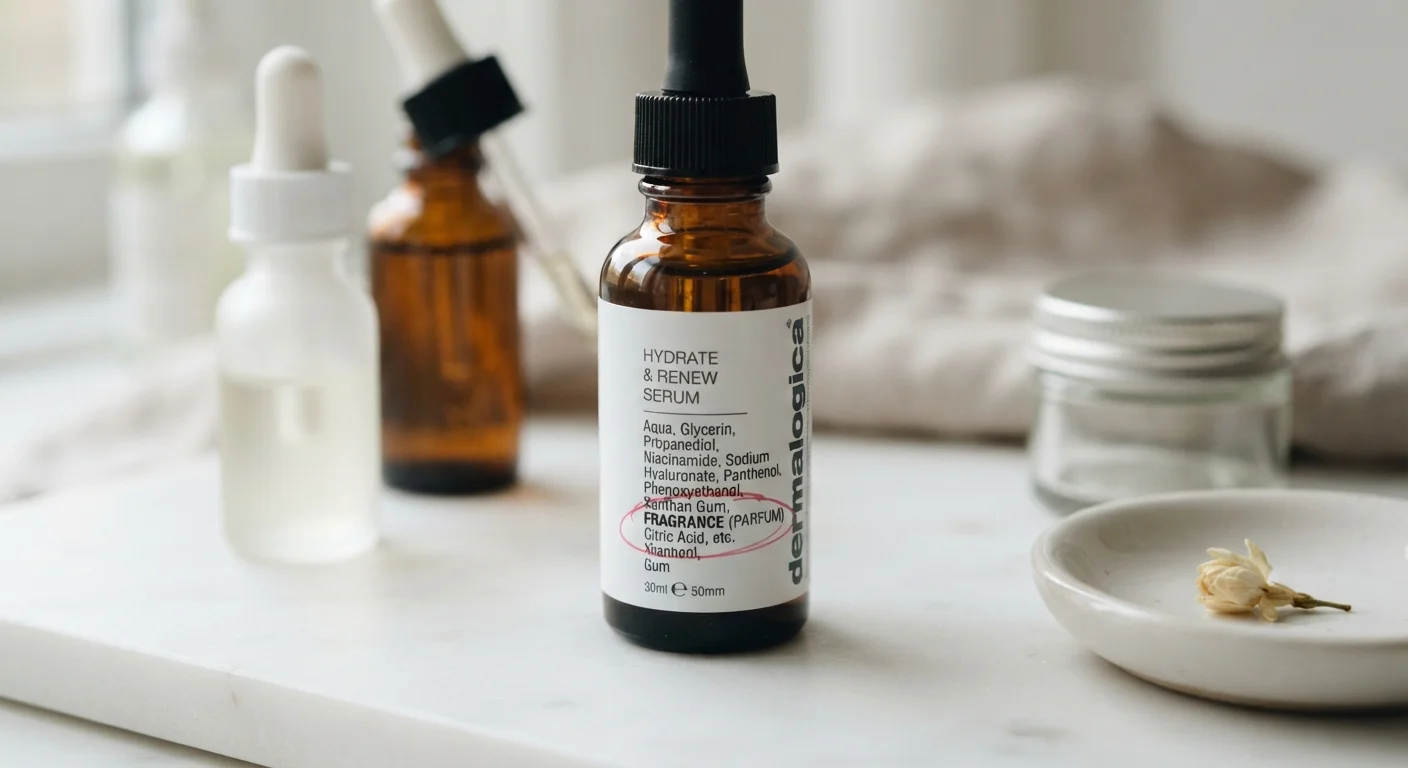
The word fragrance - or its European equivalent, parfum - operates entirely differently from every other item on that list. While "niacinamide" refers to one specific compound and "glycerin" means glycerin, "fragrance" can legally represent a proprietary blend of anywhere from a handful to several hundred distinct chemical ingredients. U.S. regulations classify fragrance formulas as trade secrets, meaning brands don't have to tell you what's in them.
This matters because you're essentially being asked to consent to an unknown variable in your routine. For the majority of people, that unknown causes no problems. But for a meaningful portion of the population, fragrance is the culprit behind skin reactions they may have been attributing to something else entirely. See our plain-language guide to cosmetic ingredient lists for broader context on how these labels are structured.
A Note on Label Transparency Variation
Fragrance disclosure standards differ significantly by country. The U.S. requires fragrance to appear on the label but doesn't mandate disclosure of individual components. The EU has stricter requirements for specific allergens. Some brands voluntarily go further than either standard by publishing full fragrance ingredient breakdowns - a practice worth looking for if transparency matters to you.
The Skin Sensitivity Connection
Fragrance consistently ranks as one of the leading causes of allergic contact dermatitis - an immune-driven reaction that produces redness, itching, and sometimes blistering at the site of contact. It can also cause irritant contact dermatitis, a non-immune reaction that simply results from chemical irritation of the skin barrier.
What makes fragrance particularly tricky is timing. Reactions don't always appear immediately. Allergic contact dermatitis can develop hours after exposure, making it genuinely difficult to connect the reaction to a specific product - let alone a specific ingredient within that product. And sensitivity can develop over time: a formula you've used without incident for years can suddenly trigger a reaction as cumulative exposure crosses a threshold.
~1 in 10
People affected by fragrance allergy
Research published in dermatology literature estimates fragrance allergy affects roughly 1-11% of the general population, with higher rates among those with existing skin conditions.
26
Fragrance allergens the EU requires disclosed
The European Union mandates individual labeling of 26 specific fragrance allergens above defined concentration thresholds in cosmetic products - a requirement that doesn't exist in U.S. federal law.
Top 5
Fragrance ranks among cosmetic allergens
Fragrance is consistently identified among the top causes of allergic contact dermatitis from cosmetics in patch test studies conducted by dermatology clinics.
People with eczema, rosacea, or generally reactive skin are at higher risk, but sensitivity isn't limited to those with pre-existing conditions. Dermatologists often recommend fragrance-free formulas as a first step when troubleshooting unexplained skin irritation - not because fragrance is universally harmful, but because eliminating it narrows the field of suspects significantly. This kind of ingredient-aware thinking also applies when you explore ingredient combinations that can cause irritation.
Decoding the "Natural" and "Unscented" Loopholes
Two label phrases trip up even careful shoppers: "natural fragrance" and "unscented."
Natural fragrance sounds reassuring, but it doesn't mean hypoallergenic or even necessarily gentler. Essential oils - lavender, bergamot, lemon, rose - are among the most well-documented skin sensitizers in dermatology literature. The origin of a fragrance ingredient (botanical vs. synthetic) doesn't reliably predict its irritation potential. Limonene, a naturally occurring compound in citrus, is a recognized allergen. Linalool, found in hundreds of plants, is another. Some synthetic aroma compounds are actually better characterized and more predictable in their safety profiles than complex natural extracts.
Unscented is a different loophole. It means the finished product has no detectable smell - but that can be achieved by adding masking fragrances that neutralize odor without contributing one of their own. These compounds still appear in the formula; they're just doing a different job. If your skin reacts to fragrances, an unscented product isn't necessarily safer than a scented one. Fragrance-free - meaning no fragrant compounds were added at all - is the designation worth seeking out if sensitivity is a concern.
Simplify Your Search for Fragrance-Free Products
When scanning an ingredient list, search for both "fragrance" and "parfum" - they're the same umbrella term in different languages. Also scan for essential oils listed by botanical name (e.g., Lavandula angustifolia oil, Citrus limon peel oil) - these are fragrant compounds that may not be grouped under the fragrance heading but carry similar sensitivity considerations.
How to Read Labels More Deliberately
Since U.S. labels won't break down fragrance blends, your options for getting more information require going beyond the packaging itself.
- Check brand transparency databases. Some companies voluntarily publish full ingredient disclosures online. Databases like the Environmental Working Group's Skin Deep catalog fragrance ingredient data where brands have provided it.
- Look at EU-format labels. European regulations require disclosure of 26 specific fragrance allergens above certain concentration thresholds. If a product is sold in both markets, the EU label version may carry more specificity.
- Note where fragrance falls on the list. Ingredients are listed in descending order of concentration. Fragrance near the very bottom suggests a lower concentration - though even trace amounts can provoke reactions in sensitive individuals.
- Cross-reference with marketing claims on skincare packaging. Language like "calming," "gentle," or "clean" doesn't have a regulated definition and doesn't guarantee the product is fragrance-free.
Reading labels is a skill that compounds over time. The more you understand about how ingredient lists are constructed, the easier it becomes to spot what's actually in - and missing from - the products you use every day.
This article is for general informational purposes only and is not a substitute for professional medical or dermatological advice. If you experience persistent skin reactions, consult a qualified healthcare provider.