Why the Label Exists - and What It Can't Tell You
The Nutrition Facts label was introduced by the FDA in 1994 and significantly updated in 2020. Its purpose is standardized disclosure: every manufacturer must report the same core nutrients in the same format, making comparison possible across brands and products. That standardization is genuinely useful - but the label has limits. It reflects nutrients per serving, not overall diet quality, and it says nothing about how a food was grown, processed, or sourced.
Front-of-package claims operate under looser rules. The Nutrition Facts panel and ingredient list are the reliable parts of a food package. Everything on the front is marketing unless it carries a specific, legally defined term like 'low sodium' or 'reduced fat,' which do have FDA definitions.
Front-of-Package Claims Can Be Misleading
Terms like 'natural,' 'made with real fruit,' or 'multigrain' are loosely regulated and can appear on products with high added sugar or sodium. Always flip the package and read the actual Nutrition Facts panel and ingredient list before drawing conclusions about a food's quality.
Understanding the label is one piece of making smarter food choices. For broader grocery strategies, our nutrition myths article addresses common misconceptions that often influence purchasing decisions.
This Is General Information, Not Medical Advice
The guidance in this article is intended for general educational purposes. Individual nutritional needs vary significantly based on age, health conditions, medications, and other factors. Always consult a qualified healthcare provider or registered dietitian for advice tailored to your specific health situation.
How to Read the Label Step by Step
The steps below walk through the Nutrition Facts panel in the order it appears - from top to bottom. Following this sequence helps you build a complete picture of a food rather than fixating on a single number.
What you will need
The food package itself
The Nutrition Facts panel, ingredient list, and front-of-package claims are all printed on the product - no app required.
USDA FoodData Central (online database)
A free, government-maintained database useful for looking up nutrient profiles of whole foods that don't carry a label.
Start with the serving size
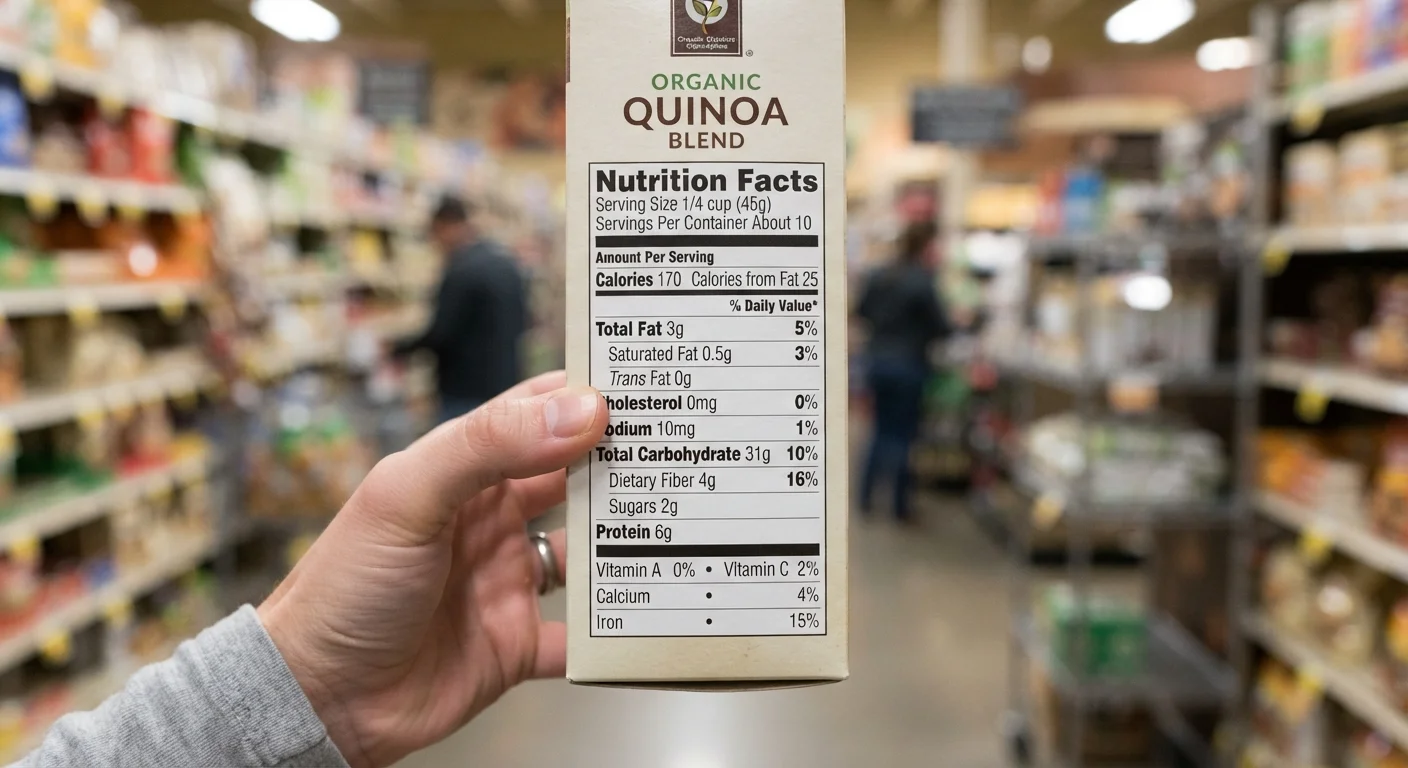
The very top of any Nutrition Facts panel lists the serving size and the number of servings per container. Every calorie count and nutrient figure on the label is calculated for that one serving - not the whole package. A bag of chips labeled '150 calories' might contain three servings, meaning the entire bag delivers 450 calories. Before reading anything else, decide how many servings you'll realistically eat and multiply accordingly.
Check total calories per serving
Directly below the serving information, you'll find calories per serving in large type. This number reflects the total energy - from fat, carbohydrates, and protein combined - in one serving. Calories matter in the context of your overall daily intake, but they don't tell the whole story about nutritional quality. A 200-calorie food rich in fiber and protein is nutritionally different from a 200-calorie food made mostly of added sugar.
Scan the 'limit these' nutrients
The FDA groups certain nutrients under an implicit 'limit these' category because most Americans already consume them in excess. These include:
- Saturated fat - linked in research to cardiovascular risk when consumed in large amounts
- Sodium - a leading contributor to high blood pressure at high intakes
- Added sugars - distinguished from naturally occurring sugars and associated with excess calorie intake
Check their % Daily Value figures. For most people, keeping these low across a day's eating is a reasonable general goal, though individual health needs vary.
Look for the 'get enough of' nutrients
Below the limiting nutrients, you'll find a second group worth actively seeking out: dietary fiber, vitamin D, calcium, iron, and potassium. These are nutrients many Americans fall short on. A higher % Daily Value for these is generally a positive signal. Fiber, in particular, supports digestive health and satiety - and is worth scanning for across grocery purchases.
Use the % Daily Value column as a compass
The % Daily Value (%DV) column runs down the right side of the panel. These percentages are based on a 2,000-calorie daily reference diet established by the FDA. They allow you to compare foods quickly without calculating exact grams. The %DV is especially useful for spotting outliers - a single serving of a canned soup at 40% DV for sodium, for example, is a meaningful data point.
Read the ingredient list
The ingredient list, usually found below or beside the Nutrition Facts panel, is ordered by weight from greatest to least. The first three to five ingredients give you the clearest picture of what the food actually is. Whole foods like 'whole wheat flour' or 'oats' near the top are generally a positive indicator. A long list of unfamiliar chemical names doesn't automatically mean a food is unhealthy, but understanding the basics helps. For broader context on how nutrients fit into daily eating, the Nutrition Fundamentals reference is a useful companion resource.
The 5% and 20% Rule of Thumb
The FDA offers a quick guideline: 5% Daily Value or less for a nutrient is considered low, while 20% or more is considered high. Use this shortcut to quickly assess whether a food is a meaningful source of a nutrient - or whether it's delivering more of something (like sodium) than you might want.
Putting It Into Practice at the Store
Label reading becomes faster with repetition. A practical approach: pick one or two nutrients most relevant to your health goals and scan for those consistently, rather than trying to analyze every figure on every product. Over time, patterns emerge - you'll start to recognize which food categories tend to be sodium-dense, which ones deliver meaningful fiber, and where added sugars are most likely to appear in unexpected products.
Comparing unit prices alongside nutrition labels helps you find nutritious options that also fit your budget. Our unit price math guide explains how shelf tags can help you compare true value across package sizes. The goal isn't a perfect diet built on label arithmetic - it's building enough literacy to make reasonably informed choices, consistently, without spending extra time or money you don't have.
This article provides general nutritional information for educational purposes only and does not constitute medical or dietary advice. Consult a qualified healthcare provider or registered dietitian before making changes based on your individual health needs.