Why Pet Food Labels Are Confusing by Design
Pet food packaging is built to sell as much as to inform. Manufacturers are required to include specific regulated elements, but they are also free to surround those elements with marketing language that can muddy the picture considerably. Understanding which parts of the label are regulated - and which are not - is the foundational skill every owner needs.
In the U.S., pet food labeling is primarily regulated by the FDA at the federal level and by individual state feed control officials, most of whom adopt AAFCO's model regulations. This framework mandates what must appear on a label and in what format, but it leaves significant room for promotional language that carries no enforceable nutritional meaning.
For a broader look at how this compares to human food labeling, our overview of reading a pet food label without the confusion covers the same territory in a complementary format. And if you want to understand the full context of feeding your pet across their lifetime, Pet Food Nutrition from First Bag to Daily Routine is a useful broader reference.
Labels Are Not a Substitute for Vet Guidance
This article is general educational information, not veterinary advice. If your pet has a health condition, age-related needs, or has been prescribed a therapeutic diet, consult your veterinarian before changing foods. Label reading is a useful skill, but it works best alongside professional guidance.
What You Need Before You Start
Label reading is a practical skill you can develop with any bag or can in front of you. Before working through the steps below, gather what you need.
What you will need
Pet food label or packaging
The physical label is what you will be reading and interpreting throughout this guide.
AAFCO nutrient profiles (publicly available)
Provides the official nutrient minimums your pet's food should meet by species and life stage.
Veterinarian or board-certified veterinary nutritionist
Offers personalized guidance when a pet has specific dietary needs that go beyond general label reading.
Once you have a label in hand, work through each regulated element in order. The steps below follow the sequence that generally yields the clearest picture of what a food actually provides.
Step-by-Step: Reading Every Required Label Element
Find the AAFCO Nutritional Adequacy Statement
This small block of text - often on the back or side of the bag - is the most regulated piece of information on the entire label. It will say something like: "[Product name] is formulated to meet the nutritional levels established by the AAFCO Dog Food Nutrient Profiles for maintenance."
AAFCO (the Association of American Feed Control Officials) sets minimum and maximum nutrient levels for pet foods by species and life stage. A food that carries this statement has either been formulated to meet those levels or has passed a feeding trial. For a deeper look at what this statement actually certifies, see what the AAFCO statement actually means.
Check the Life-Stage Claim
The AAFCO statement will specify which life stage the food is designed for: growth (puppies or kittens), maintenance (adult animals), gestation/lactation, or all life stages. A food labeled 'all life stages' must meet the most stringent tier - the growth profile - making it suitable but sometimes higher in certain nutrients than an adult animal strictly needs.
Feeding an 'all life stages' food to a senior pet, for example, may provide more phosphorus or protein than that animal requires. It is not necessarily harmful, but it is worth discussing with your vet if your pet has kidney concerns or other age-related conditions.
Read the Ingredient List Critically
Ingredients are listed in descending order by pre-cooking weight, not by nutritional contribution. This is an important distinction. A whole meat like chicken listed first is largely water weight; after cooking, it contributes less protein by mass than a named meat meal (e.g., chicken meal) listed lower down. Neither position alone tells you the food is good or bad - it tells you relative weight before processing.
Focus on whether named protein sources appear (chicken, salmon, beef liver) rather than vague terms like 'meat by-products' without a species name. Also note that a single ingredient split into multiple forms - for example, 'corn,' 'corn gluten meal,' and 'corn flour' listed separately - effectively moves that ingredient higher if combined.
Interpret the Guaranteed Analysis Panel
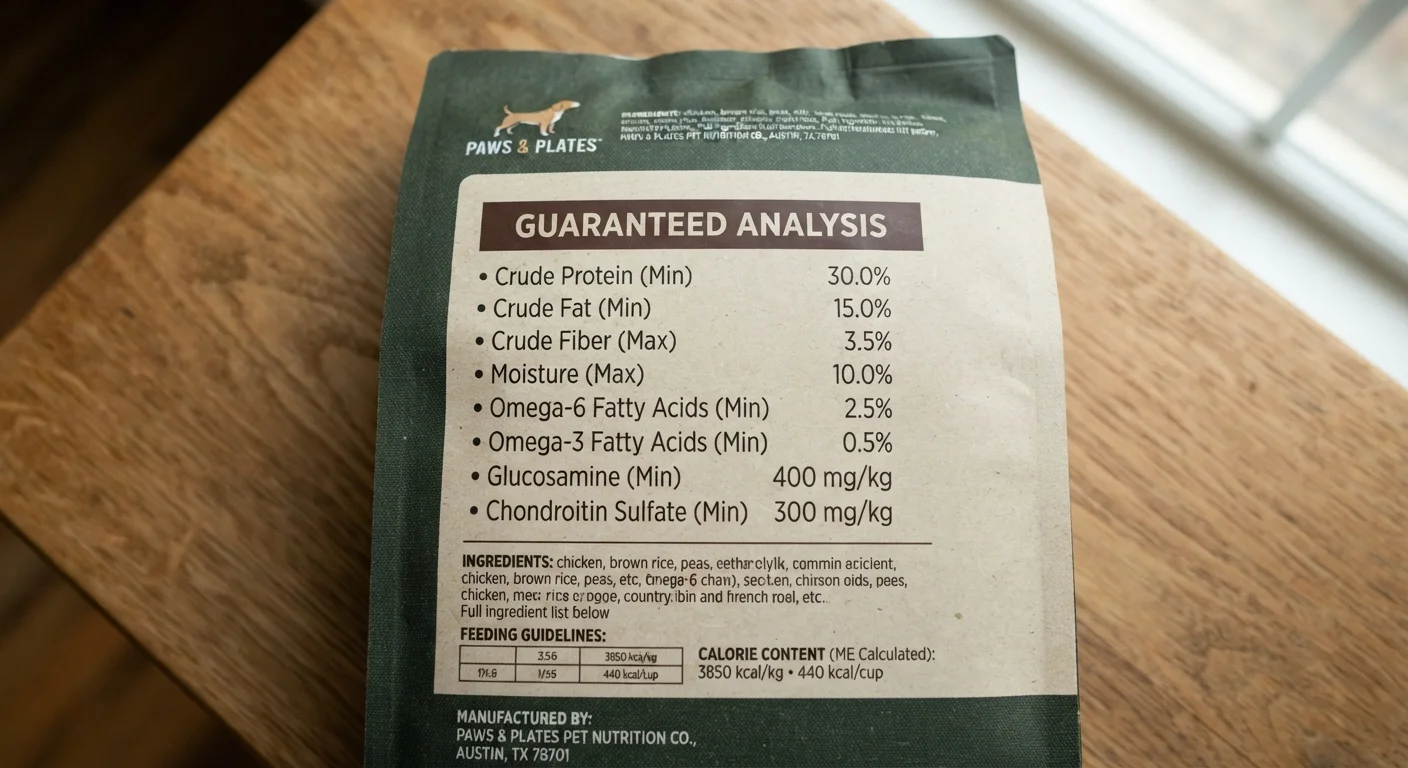
The guaranteed analysis lists minimum percentages of crude protein and crude fat, and maximum percentages of crude fiber and moisture. These are not exact nutrient amounts - they are regulatory thresholds. The actual protein in the bag may be higher than the stated minimum.
Moisture content is especially important when comparing wet and dry foods. A wet food showing 10% protein and an 80% moisture content contains far more protein per dry ounce than the label number suggests. Signs that a diet is or isn't working can complement what you learn from this panel.
Identify the Manufacturer Information
U.S. regulations require pet food labels to include the name and address of the manufacturer or distributor. This matters more than it might seem: some brands that appear different are manufactured by the same facility, and knowing who to contact matters if a recall is issued.
Check whether the label says 'manufactured by' versus 'distributed by' or 'manufactured for.' The latter two phrases indicate the brand may be contracting production to a third party. This is common and not inherently a problem, but it is useful context for traceability.
Evaluate Front-of-Bag Claims Skeptically
Front-panel language is primarily marketing. Terms like 'natural,' 'holistic,' 'premium,' and 'ancestral recipe' are not defined or enforced by federal regulation in a way that guarantees nutritional quality. Even 'grain-free' is a compositional claim, not a health claim - the science around grain-free diets and certain cardiac conditions in dogs is still being studied. For a detailed look at that evidence, see what research says about grain-free pet food.
The regulated back-of-bag elements - the AAFCO statement, ingredient list, and guaranteed analysis - are always more informative than front-panel claims.
Compare Foods on a Dry-Matter Basis
Wet and dry foods have very different moisture levels, which skews nutrient percentages. To compare them fairly, use a dry-matter basis calculation: divide each nutrient percentage by (100 minus the moisture percentage), then multiply by 100. Your veterinarian or a board-certified veterinary nutritionist can help you apply this if needed.
Unregulated Marketing Language Is Everywhere
Terms like 'premium,' 'holistic,' 'human-grade,' and 'natural' carry no standardized legal definition in pet food regulation. They appear on packaging to influence purchasing decisions, not to convey meaningful nutritional information. Focus on regulated label elements - the AAFCO statement, guaranteed analysis, and ingredient list - rather than front-of-bag claims.
Putting It All Together
A well-labeled pet food will carry a clear AAFCO adequacy statement matching your pet's life stage, an ingredient list with named protein sources near the top, a guaranteed analysis you can interpret in context, and traceable manufacturer information. No single element tells the whole story - these components work together.
If you find a food that passes all six steps but your pet shows changes in coat quality, energy, stool consistency, or weight over time, those physical signals are worth just as much as what the label says. See signs a pet's diet is working - and signs it isn't for what to monitor between vet visits.
Budget is a real factor for most owners. The good news is that label literacy helps you spend more wisely rather than more expensively. Stretching your pet food budget without cutting nutritional corners offers concrete strategies for applying what you've learned here without overspending.
This article provides general educational information about pet food labeling and is not a substitute for veterinary advice. Always consult a licensed veterinarian for guidance specific to your pet's health, age, or nutritional needs.