
What Dolby Atmos Actually Does to Sound
Traditional surround sound - the kind labeled 5.1 or 7.1 - divides audio into fixed channels assigned to specific speaker positions around a horizontal plane. Dolby Atmos discards that ceiling. It encodes audio as individual objects with position data, allowing a mixing engineer to place a raindrop, a helicopter, or a whisper at any point in a three-dimensional sphere around the listener.
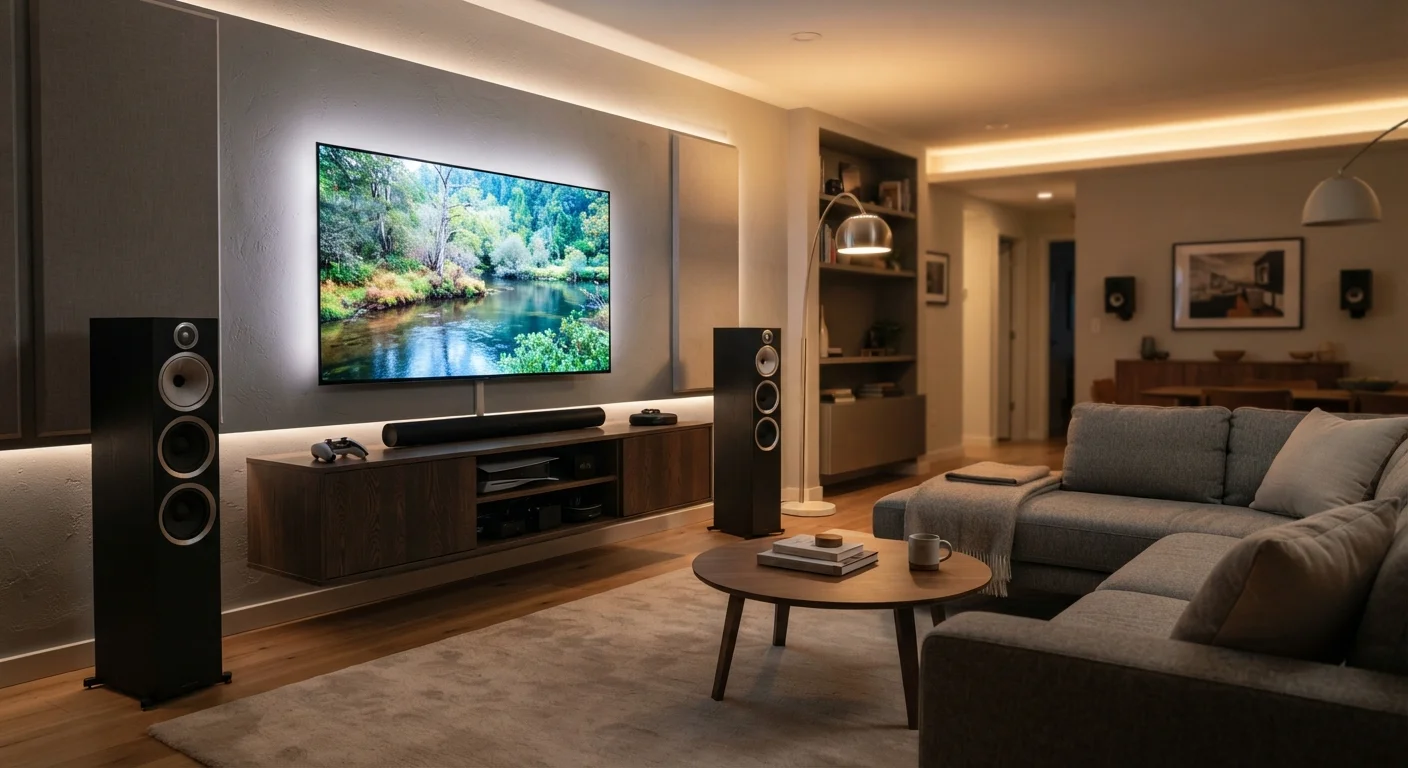
When a compatible system decodes that signal, it maps those objects to whatever speakers are available - whether that's a pair of ceiling speakers in a dedicated home theater or upward-firing drivers in a soundbar bouncing sound off your ceiling. The format adapts to the hardware rather than requiring a fixed configuration.
In practice, well-implemented Atmos feels like a wider, taller soundstage. Effects that previously arrived from left or right now appear to arc overhead. Ambient layers - rain, crowd noise, environmental reverb - wrap around the listener rather than sitting in front. The difference is most apparent in action films and concert recordings; dialogue-heavy content shows less dramatic change.
5.1.2
Minimum recommended Atmos speaker configuration
Dolby's own guidelines describe 5.1.2 as the entry point for genuine height-channel reproduction in a home environment.
128
Maximum simultaneous audio objects in Atmos
The Dolby Atmos specification supports up to 128 simultaneous audio objects per mix, giving sound designers precise spatial control.
eARC
HDMI connection required to pass Atmos signal
HDMI eARC (Enhanced Audio Return Channel) is the standard connection that allows full-bandwidth Atmos audio to pass from a TV to an external audio device.
The Full Signal Chain: Content, Decoder, and Speakers
Three things must align for Atmos to work at home. First, the content must carry an Atmos soundtrack - not every title does, even on platforms that support the format. Second, a compatible decoder must receive and interpret the signal. Third, the playback system must have some way to reproduce height audio.
The decoder lives in your AV receiver or your soundbar, not in your TV. Most televisions pass the audio signal downstream via HDMI eARC (Enhanced Audio Return Channel) to whichever device handles decoding. If that connection or device is missing, the Atmos layer never arrives. This is the single most common reason listeners don't hear what they expect after purchasing Atmos-labeled hardware.
For speaker setups, Dolby's notation system tells you exactly what you have. A 5.1.2 system means five surround speakers, one subwoofer, and two height channels. A 7.1.4 system adds more surround and height speakers. The height number - the third digit - is what separates Atmos-capable systems from conventional surround. See our first-timer's guide to building a home audio system for a deeper walkthrough of how receivers, speakers, and subwoofers fit together.
Check Your HDMI Port Before Buying
Before purchasing any Atmos-capable soundbar or receiver, confirm your TV has an HDMI eARC port - not just a standard ARC port. ARC can pass Atmos in some compressed forms, but eARC handles the higher-bandwidth lossless version. The port is typically labeled on the TV's back panel or in the owner's manual.
Soundbars vs. Physical Height Speakers
Upward-firing drivers in a soundbar or tower speaker reflect sound off the ceiling to simulate height. This approach genuinely works in rooms with flat, low-to-medium ceilings - typically eight to ten feet. In rooms with vaulted ceilings, heavy acoustic treatment, or highly textured surfaces, the reflections scatter and the height effect weakens or disappears.
Dedicated ceiling speakers or in-ceiling mounts eliminate the reflection dependency and deliver the most consistent, accurate height rendering. They also require installation, wiring, and an AV receiver rather than a simple soundbar connection. For most apartment dwellers or renters, a quality Atmos soundbar is the realistic path; homeowners with more flexibility benefit more from a full speaker layout.
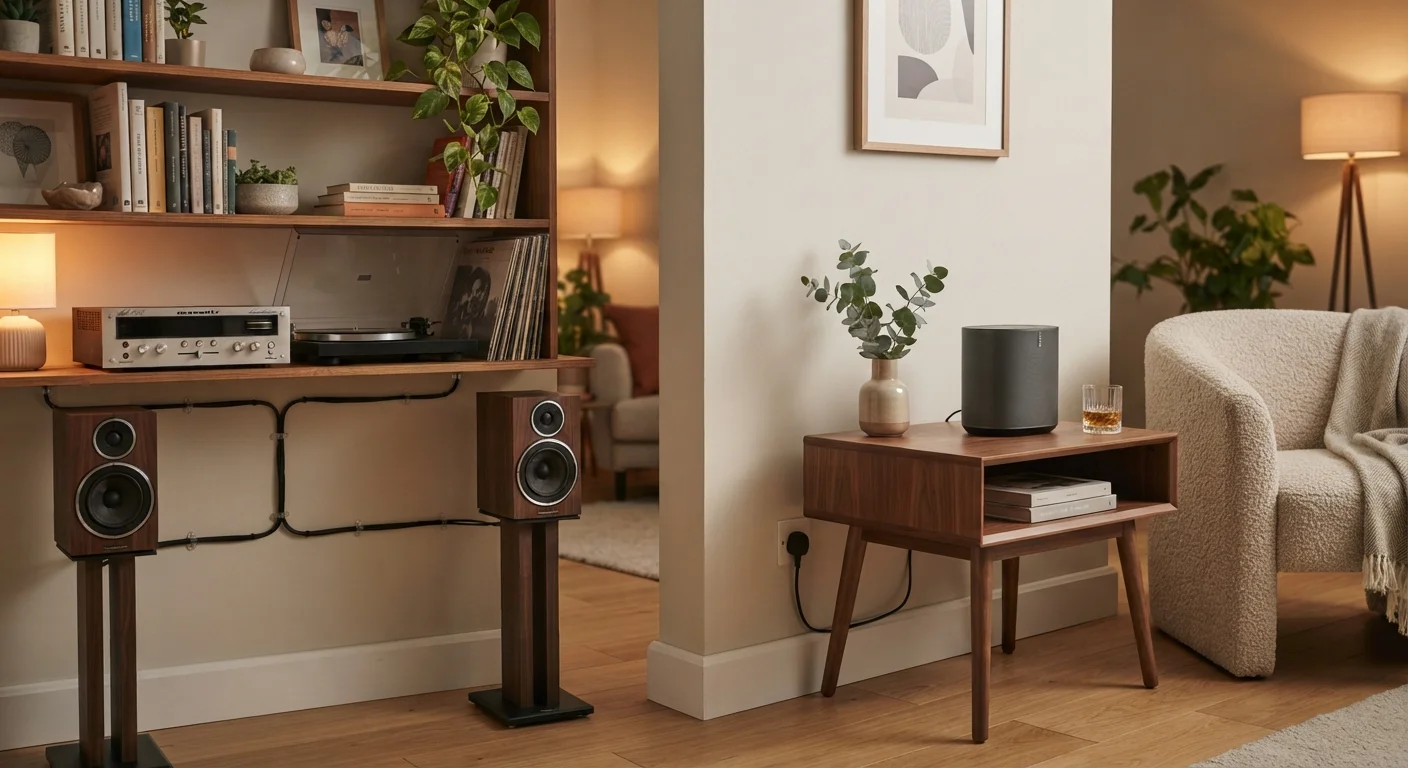
Matching audio hardware to your space involves more than format support - room size, ceiling height, and listening habits all factor into which approach actually sounds better in your home. For a look at connectivity trade-offs between wired and wireless speaker options, see wired vs. wireless home speakers.
“The goal of object-based audio isn't just more speakers - it's removing the listener's awareness of the speakers entirely. When it works, you stop hearing a system and start hearing a place.”
— Tomlinson Holman, Audio engineer and inventor of THX sound system standards
Where Atmos Content Comes From and What to Expect
Atmos soundtracks are available across several delivery formats. 4K Blu-ray discs carry lossless Atmos audio - the highest-fidelity version of the format. Streaming platforms deliver compressed Atmos, which still performs well but encodes the audio at lower bitrates. Gaming consoles support Atmos for compatible game audio engines, though implementation varies by title.
Not all content on an Atmos-capable platform carries an Atmos mix. Studios must choose to create and distribute the mix separately. When shopping for content, look for explicit Atmos labeling in the title's audio specifications rather than assuming it's included because the platform supports the format.
Dolby Atmos also intersects with video quality in a consumer-relevant way: the same discs and streams that carry Atmos audio often carry advanced video formats. For a parallel look at how HDR formats work on the video side - and why the same full-chain principle applies - see HDR formats compared. Getting both audio and video right requires understanding each layer of the delivery chain.
Atmos and DTS:X Are Competing Formats
DTS:X is a competing spatial audio format with similar object-based principles. Most modern AV receivers decode both, but soundbars vary - some support only Atmos, others support both. If you rent or stream heavily from a platform that favors one format, verify your hardware decodes it. Content availability differs by platform and region.