How Each Technology Actually Works
The single most important distinction between OLED and QLED is where the light comes from - and whether each pixel controls it independently.
OLED stands for Organic Light-Emitting Diode. Every pixel in an OLED panel generates its own light. When a scene calls for black, those pixels switch off entirely, producing a true zero-light black rather than a dimmed approximation. This per-pixel control is the foundation of OLED's renowned contrast performance.
QLED stands for Quantum Light-Emitting Diode - though the name is something of a marketing simplification. A QLED panel is fundamentally an LCD screen with a quantum dot enhancement layer. The quantum dots are tiny semiconductor crystals that convert the backlight's blue LED light into more precise red and green wavelengths, producing a wider and more saturated color gamut. The backlight itself remains a single or multi-zone source behind the liquid crystal layer, not an array of individually controlled pixels.
This structural difference shapes nearly every performance trade-off between the two. For a deeper look at how panel type interacts with resolution and screen size, see our display specs guide.
| Criterion | OLED | QLED |
|---|---|---|
| Light source | Each pixel self-illuminates | LED backlight + quantum dot layer |
| Black level | True black (pixel off) | Very dark grey (backlight dimming) |
| Peak brightness | Moderate to high | High to very high |
| Contrast ratio | Effectively infinite | High, but finite |
| Viewing angles | Excellent off-axis accuracy | Varies by LCD panel type |
| Burn-in risk | Present with static content | No burn-in risk |
| Color volume at peak brightness | Some compression at extremes | Strong saturation at high brightness |
| Typical price range | Mid to premium | Budget to premium |
Brightness, Black Levels, and Contrast
Contrast ratio - the difference between the darkest black and the brightest white a screen can display simultaneously - is where OLED and QLED diverge most sharply.
Because OLED pixels switch off completely, the technology achieves what manufacturers call an "infinite" contrast ratio. No backlight bleeds into adjacent dark areas. In practice, this means shadow detail in films and dark scenes looks genuinely deep rather than grey.
QLED counters with raw brightness. Many QLED panels can sustain peak brightness levels that current OLED screens cannot consistently match, which matters for HDR highlights - the specular glints on water, the sun in an outdoor scene. For HDR format compatibility, our HDR formats comparison covers how HDR10, Dolby Vision, and others interact with panel performance.
0 nits
OLED minimum black level
OLED pixels that switch off completely emit no measurable light, a physical property that LCD-based panels cannot replicate regardless of local dimming implementation.
2,000+
Peak nits on flagship QLED panels
Many high-end QLED televisions are rated above 2,000 nits peak brightness, a level that allows HDR highlights to appear with significant visual impact in well-lit spaces.
~30°
Angle before VA-panel contrast drops
VA-type LCD panels, common in QLED sets, can begin showing noticeable contrast loss at viewing angles beyond roughly 30 degrees off the center axis.
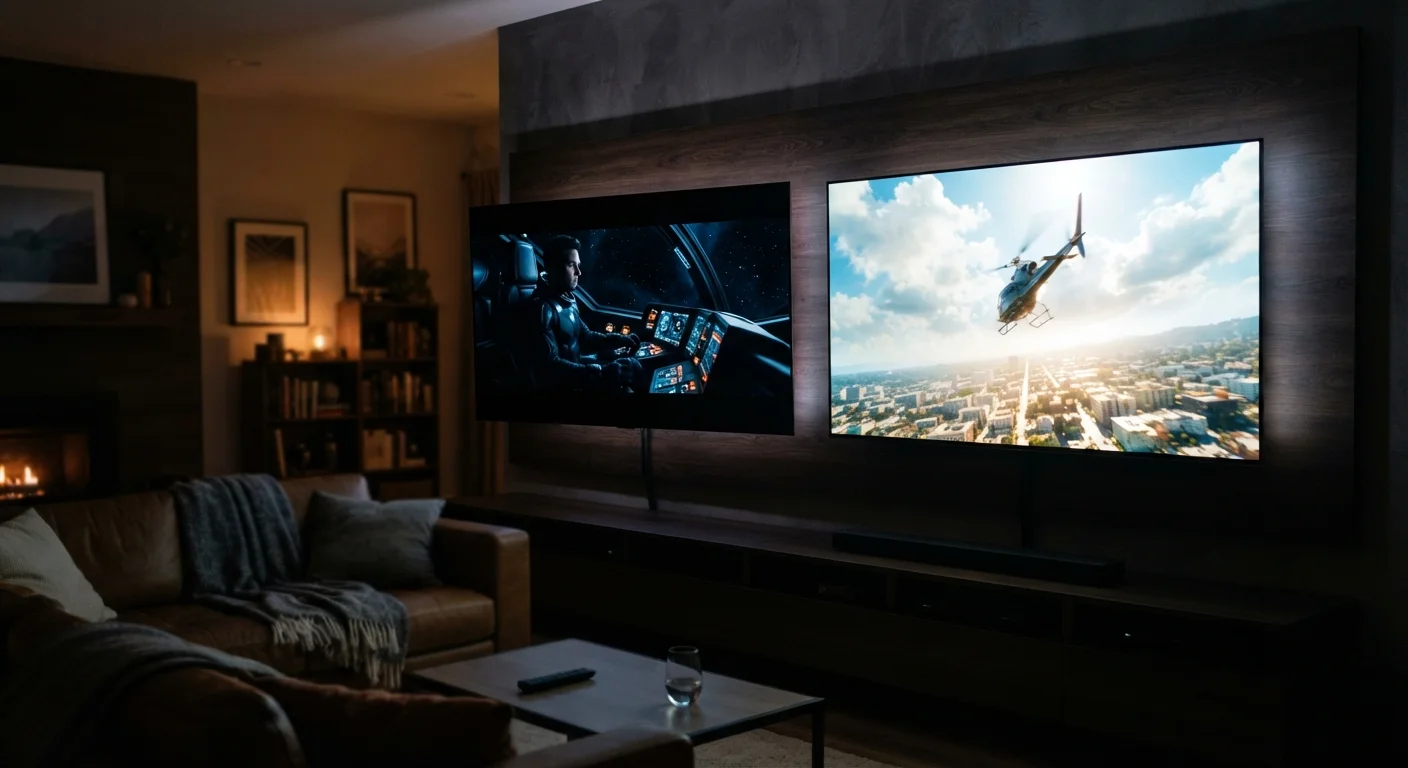
The practical takeaway: in a dark room, OLED's contrast advantage is visible and immediate. In a bright room where ambient light raises the perceived black floor anyway, QLED's brightness advantage becomes more relevant. Our bright-room setup guide covers how placement and panel traits interact with ambient light.
Color, Viewing Angles, and Longevity
Both technologies can produce wide color gamuts suitable for HDR content, but they reach that result differently and with different side effects.
QLED's quantum dot layer allows it to cover a broad color volume - particularly at high brightness levels where OLED color saturation can compress slightly. If a panel's brightest HDR moments also need to be the most saturated, QLED has a structural advantage there.
Viewing angle is a consistent OLED strength. Because each pixel emits light directly, the image remains accurate from seating positions well off to the side. Many QLED sets use VA-type LCD panels, which can show contrast and color shift as viewers move away from center. Some QLED models use IPS-type LCD panels, which have better off-axis performance but typically lower native contrast.
Burn-in is the most frequently cited OLED concern. Displaying a static image - a network logo, a game HUD, a news ticker - for thousands of hours can cause permanent image retention in OLED panels. Manufacturers have added pixel-shift and screen-saver technologies to reduce the risk substantially, and real-world reports from typical TV viewers are relatively rare. Still, for commercial or gaming use with persistent static elements, QLED eliminates the concern entirely.
Burn-In Risk in Context
OLED burn-in is a real phenomenon but is strongly associated with specific high-risk use cases: displaying a static image continuously for thousands of hours. Typical mixed-use TV viewing - streaming, sports, occasional gaming - presents a much lower risk profile. Modern OLED TVs include automatic pixel-refresh cycles and logo-dimming features that further reduce the likelihood. Viewers with niche use cases involving static overlays should weigh this more carefully.
For full context on the spec sheet numbers - refresh rate, local dimming zones, nit ratings - our TV spec sheet guide explains which figures actually affect daily viewing. And if you're still sorting out resolution alongside panel type, TV resolution explained provides a plain-English breakdown.